10 Healthtech Video Examples That Convert
TL;DR
- The healthtech videos that convert aren't the flashiest — they're the ones that answer buyer hesitation directly: trust, clinical credibility, and proof of workflow change.
- The 10 examples here span four format types: brand credibility videos, product demos, AI/clinical tools, and innovative UI-forward formats — each matched to a specific stage of the healthtech buyer journey.
- Every company featured is real; every video or channel linked is publicly accessible and verified.
- The recurring pattern across all 10: open with the cost of inaction, close with the simplest possible next step.
Table of Contents
- Why Healthtech Video Marketing Is Different
- The 4 Video Formats That Drive Pipeline in Healthtech
- Examples 1–4: Brand Credibility & ROI Videos
- Examples 5–7: Product Demo & Workflow Explainers
- Examples 8–10: Innovative Formats Gaining Traction
- What Separates Converting Healthtech Videos
- How to Apply These Lessons to Your Healthtech Brand
- FAQ
Most healthtech marketing teams know video works. What's less clear is which videos work — and why.
The healthtech category has unique conversion friction. Your buyers are often clinicians, hospital administrators, HR leaders, or benefits managers. They carry institutional risk, face regulatory scrutiny, and are skeptical of vendor claims by default. A product that sounds brilliant in a demo can feel impossible to evaluate when the stakes involve patient safety or compliance.
Video that converts in this environment doesn't need bigger production budgets. It needs credibility architecture — the right framing, proof types, and call-to-action for the specific fear your buyer carries into the conversation.
This post breaks down 10 real healthtech video examples that get that architecture right. For each, we look at who the buyer is, what conversion barrier the video addresses, and the one structural decision that makes it work.
If you're planning your own healthtech video marketing program, these examples give you a tested framework to work from — not a mood board.
Why Healthtech Video Marketing Is Different
Healthtech marketing operates under constraints that generic SaaS playbooks ignore. Understanding these constraints is the prerequisite for producing video that actually converts — not just impresses.
Buyers Carry Institutional Risk
The person watching your video is rarely the only decision-maker. A VP of Clinical Operations approving a new workflow tool is also accountable to CIOs, CMOs, and compliance teams. Your video needs to give them the language to sell internally — not just the emotional motivation to buy. That means stating ROI in terms of FTE hours saved, discharge delays reduced, or claim denials avoided — not just "streamlined workflow."
Trust Has a Clinical Dimension
In most SaaS categories, a polished product demo builds trust. In healthtech, buyers also need to trust that you understand clinical reality — the workflow, the EHR integration, the regulatory environment. Videos that skip this dimension feel generic and untrustworthy to clinical buyers, even if the product is genuinely strong.
The Sales Cycle Is Long
Enterprise healthtech deals commonly span many months. Video content at the top of funnel (brand awareness) serves a different purpose than video at the bottom (procurement committee justification). The examples in this post span that entire funnel — and the structural differences between them are intentional, not accidental.
For a broader view of how the video marketing funnel maps to healthtech buyer stages, see our guide to SaaS video production strategy.
The 4 Video Formats That Drive Pipeline in Healthtech
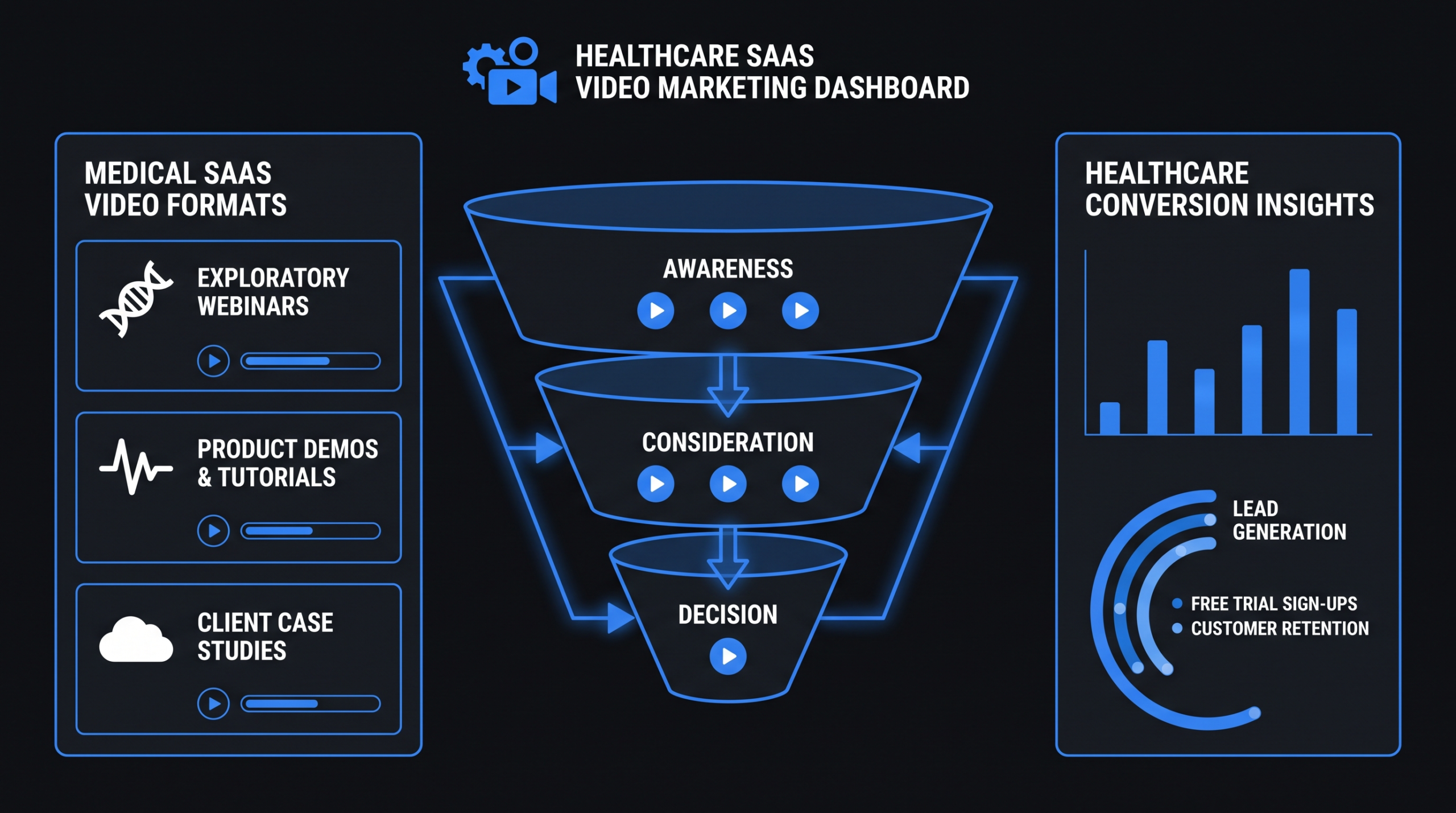
Before the examples: a framework. Healthtech companies that consistently generate pipeline from video operate across four format types, each matched to a specific buyer moment.
Healthtech Video Format Framework
| Format | Buyer Stage | Primary Job | Typical Length |
|---|---|---|---|
| Brand credibility | Awareness | Establish that the problem is real and you're the credible authority | 60–120 sec |
| Product demo / explainer | Consideration | Show the workflow change in concrete terms | 90–180 sec |
| Clinical proof / testimonial | Evaluation | Provide third-party validation from a trusted clinical voice | 2–4 min |
| ROI / enterprise case study | Decision | Give procurement the numbers to justify the investment | 3–5 min |
The 10 examples below map across all four formats. Pay attention to which format each company chose — it's rarely an accident.
Examples 1–4: Brand Credibility & ROI Videos
These videos don't demo features. They establish the stakes, demonstrate category authority, and make the buyer feel that the company understands their world. They're designed to create pull — buyers who arrive at the demo already convinced that the problem warrants serious attention.
Example 1: Teladoc Health — "How Teladoc Health Is Transforming Healthcare"
Company: Teladoc Health | Video: Watch on YouTube
Teladoc's enterprise-facing video doesn't open with features — it opens with outcomes. The video is built around the ROI logic that self-insured employers and health plans use to justify virtual care investment: capacity expansion, access improvement, and measurable health outcomes.
What makes it convert: The video speaks directly to payer and employer buyers in their language — cost per member, care capacity, clinical ROI. Every claim is contextualized in terms of the buyer's business outcome, not Teladoc's product. The production uses high-production B-roll of real care delivery, which anchors the virtual care concept in recognizable clinical reality. The CTA is implied but clear: if your health system or employer program needs these outcomes, Teladoc is the conversation.
The structural lesson: Lead with the downstream value (outcomes, ROI, access) and let the product earn its place in the story — rather than opening with "here's what our platform does."
Example 2: Hinge Health — Chronic MSK Care Program
Company: Hinge Health | Video: Watch on YouTube
Hinge Health's video marketing faces a specific credibility challenge: convincing HR and benefits buyers that a digital physical therapy program can actually replace or defer surgery and opioid prescriptions — claims that sound too good to be true without the right proof structure.
What makes it convert: The video uses a dual-audience approach — it speaks to both the member (who experiences the pain) and the employer buyer (who cares about cost and productivity outcomes). By showing the member experience in concrete terms — exercise therapy through a sensor-guided app, coaching, and personalized care plans — it gives the benefits buyer a believable picture of how the program actually gets used. That believability is the conversion asset, not the production quality.
The structural lesson: For digital health products that require behavior change, showing the member or patient experience is often more persuasive to the B2B buyer than showing dashboards or admin features.
Example 3: Dexcom — G7 System Overview
Company: Dexcom | Video: Watch on YouTube
Dexcom's G7 overview video is a masterclass in using premium visual production to reduce purchase anxiety around a medical device. The continuous glucose monitor (CGM) category carries high stakes — buyers are people living with diabetes who need to trust a device they'll wear on their body 24/7.
What makes it convert: The video uses high-fidelity 3D animation to show the G7 sensor from every angle, then transitions seamlessly to showing data flowing to the connected smartphone app. This "hardware to software" visual bridge answers the buyer's unspoken question: how does a small patch on my arm become useful health data I can act on? Production quality itself becomes a trust signal — if Dexcom invests this heavily in showing how the device works, they're likely as rigorous about building it.
The structural lesson: For medical devices, 3D product visualization isn't a luxury — it's a trust-building mechanism that static product photography can't replicate. The device needs to feel real and well-engineered before the buyer commits to wearing it.
Example 4: Abridge — "How AI Is Changing Patient Visits"
Company: Abridge | Video: Watch on YouTube
Abridge is an AI clinical documentation platform — it records patient-physician conversations and generates structured clinical notes in real time. The core conversion challenge: clinical buyers are deeply skeptical of AI claims in healthcare. A polished brand video full of abstract AI imagery would be counterproductive.
What makes it convert: The video features a real physician — Dr. Sale — actually using the product in a real clinical context. No actors, no scripted scenarios. The doctor speaks in their own voice about what the product changes in their workflow: "less time typing, more time connecting with patients." That framing resonates because physician burnout from documentation is a recognized, pervasive problem. The production is deliberately understated — clinical buyers trust evidence over polish.
The structural lesson: For AI and clinical software, a real practitioner demonstrating the tool in authentic context converts better than any animated explainer. Authenticity is the production value that clinical buyers respond to.
Examples 5–7: Product Demo & Workflow Explainers
These videos do the work that discovery calls used to handle: showing the product in enough detail that the buyer can visualize adoption. Done well, they shorten sales cycles by answering the "but how does it actually work?" objection before it's raised.
Example 5: Zocdoc — Marketplace Booking Explainer
Company: Zocdoc
Zocdoc operates at the intersection of consumer health and B2B — they need to convince both patients to use the booking platform and healthcare providers to list on it. Their video content splits accordingly: consumer-facing videos explain the booking experience in conversational terms, while provider-facing content addresses practice growth and patient volume.
What makes it convert: The consumer-facing explainer videos use a clear three-step narrative — search, verify insurance, book instantly — with a tight call-to-action. The speed of resolution is the product benefit, so the video is paced accordingly: no long setup, no brand storytelling. The viewer gets the value proposition in under 30 seconds. For the B2B side, Zocdoc's provider explainers focus on practice growth metrics — patient volume, review reputation, appointment fill rates — in language that resonates with office managers and practice administrators.
The structural lesson: When your product serves two audiences (patient and provider, or consumer and enterprise), the conversion-optimized approach is to create separate videos that speak directly to each — rather than trying to serve both in one video and landing weakly with both.
Example 6: Phreesia — Digital Patient Intake Platform
Company: Phreesia
Phreesia provides digital patient intake and check-in software for medical practices and health systems. Their buyer is typically a practice manager, IT director, or operations VP dealing with front-desk bottlenecks, paper-based intake, and insurance verification delays.
What makes it convert: Phreesia's explainer content takes an operations-first approach — showing the current workflow pain (paper clipboards, manual insurance verification, front-desk queues) and then contrasting it with the digital workflow. The before/after structure is deliberate: it gives the operations buyer a concrete comparison point, not just a feature list. The visual language is clean and clinical — not consumer-friendly, not flashy — which is appropriate for an audience that evaluates software for reliability and ease of staff adoption, not aesthetic appeal.
The structural lesson: For B2B healthtech targeting operations and admin buyers, the "current pain → solution" before/after structure consistently outperforms feature-first demos. The buyer needs to recognize their problem before they can appreciate your solution.
Example 7: Qventus — AI Hospital Operations Platform
Company: Qventus
Qventus provides AI-powered software for hospital operations — specifically discharge planning, inpatient bed capacity management, and care team workflow automation. Their buyers are COOs, CNOs, and care operations leaders at large health systems. This is a high-ticket, long-cycle enterprise sale.
What makes it convert: Qventus uses kinetic typography combined with data visualization to show the complexity of the problem (hundreds of patients, interdependent workflows, real-time decision points) and how the AI layer simplifies it. The video speaks the language of hospital operations — discharge barriers, bed turns, care team coordination — not generic "AI efficiency" claims. Importantly, the framing is outcome-first: reduced length of stay, improved discharge predictability, better bed utilization. The video positions Qventus as an operations infrastructure layer, not a workflow management tool — which matters for an enterprise buyer justifying a seven-figure commitment.
The structural lesson: Enterprise healthtech videos need to position the product at the right altitude — strategic infrastructure, not feature set. Buyers approving large contracts need to see strategic fit before they evaluate features.
Examples 8–10: Innovative Formats Gaining Traction
These examples push beyond standard explainer formats. They're worth studying because they've earned attention in a crowded category by approaching the "how do we show this product?" question differently.
Example 8: Thatch — Personalized Health Benefits Platform
Company: Thatch
Thatch is a modern health benefits platform that allows employers to give employees personalized budgets for individual healthcare plans — essentially replacing the traditional group plan model with individual choice. The conversion challenge: health insurance is abstract and typically described in policy language that creates distance rather than engagement.
What makes it convert: Thatch's video content uses floating 3D UI panels — stylized versions of their actual product interface — to make abstract insurance choices tangible. Rather than describing "personalized budgets" in text, the video shows personalized budget cards, plan comparison views, and individual allocation decisions as floating visual objects that the viewer can almost reach out and interact with. This technique transforms a confusing product category into an intuitive visual experience. The result is a video that feels innovative enough to reassure early-adopter HR buyers that Thatch is genuinely building something new.
The structural lesson: For products in traditionally confusing or bureaucratic categories (insurance, compliance, benefits), 3D UI visualization that makes abstract choices look tangible and simple can do more conversion work than any amount of explanatory copy.
Example 9: Carepatron — Practice Management Platform
Company: Carepatron
Carepatron is an all-in-one practice management platform for healthcare providers — covering client scheduling, clinical documentation, billing, and care coordination in a single tool. Their buyers are typically solo practitioners, small clinic owners, and group practice managers evaluating practice management software.
What makes it convert: Rather than picking one feature to lead with, Carepatron's demo videos use a day-in-the-life narrative structure: following a practitioner through a typical workday and showing how each Carepatron module handles a task the viewer recognizes. The key is that the demo is anchored in a real workflow scenario, not an abstract feature tour. This structure is particularly effective for broad-platform tools where the buyer's evaluation question is "will this fit how we actually work?" — which can only be answered by showing the work, not the features. The video also addresses the top objection for practice management switches (migration and learning curve) by showing how simple the day-to-day use is.
The structural lesson: For all-in-one platforms with many features, a day-in-the-life narrative consistently outperforms feature-list demos. It answers the buyer's actual question ("does this match how we work?") rather than a list of capabilities they can't contextualize.
Example 10: Tennr — AI Healthcare Operations Automation
Company: Tennr
Tennr builds AI-powered automation for healthcare operations — specifically, reading medical faxes and unstructured documents to automate patient referrals, intake, and insurance verification. Their buyer is typically a Director of Revenue Cycle, VP of Operations, or health system COO dealing with the reality that healthcare still runs on fax machines.
What makes it convert: Tennr's explainer content leads with the problem in an almost provocative way — acknowledging that healthcare's reliance on faxes and unstructured documents is absurd, and that the manual labor required to process them is both expensive and error-prone. By naming the embarrassing reality that buyers live with every day, Tennr creates immediate recognition and credibility. The AI solution is then presented not as futuristic automation, but as a practical fix to a mundane operational problem the buyer has already given up on solving. The video uses clean geometric animation — rectangles, planes, document visualizations — that mirrors the structured-chaos problem itself.
The structural lesson: For AI products solving entrenched operational problems, leading with the absurdity of the current state (rather than the novelty of the AI) creates faster buy-in. Buyers feel understood, not sold to.
What Separates Converting Healthtech Videos
Across all 10 examples, four patterns appear consistently. They don't depend on budget, production style, or company stage. They're structural decisions that anyone producing healthtech video can apply.
4 Patterns in Converting Healthtech Video
| Pattern | What It Looks Like | Why It Works |
|---|---|---|
| Open with the cost of inaction | Show the operational, clinical, or financial problem before introducing the solution | Buyers need to feel the problem before they value the solution |
| Speak the buyer's language | Use the exact vocabulary the target buyer uses internally (FTE hours, bed turns, discharge barriers, claim denials) | Language recognition creates credibility faster than feature lists |
| Show the work, not just the output | Demonstrate actual workflows, not just dashboards or results screens | Buyers evaluate "will my team use this?" — which requires seeing the work |
| Match production register to buyer trust signals | Clinical AI buyers trust understated production; consumer health buyers trust energy and simplicity; enterprise buyers trust precision and scale | Mismatched production register creates subconscious doubt about whether the company understands the buyer |
How to Apply These Lessons to Your Healthtech Brand
The gap between most healthtech marketing teams and the companies in this list isn't creative talent or production budget. It's video program architecture — knowing which videos to make, for which buyers, at which stage.
Start With One Video for One Stage
Don't try to build a full-funnel video library from scratch. Pick the stage where your biggest conversion drop-off happens. If prospects understand what you do but struggle to justify the investment internally, build an ROI-forward brand video first. If you're losing deals because buyers can't visualize adoption, prioritize a workflow demo. See our product demo video production guide for the structure that converts in SaaS and healthtech contexts.
Audit Your Buyer Language
Before scripting, pull your last 20 sales call transcripts and identify the exact phrases buyers use to describe the problem. The vocabulary they use — not the vocabulary you use to describe your product — should drive your video script. The Tennr and Abridge examples both demonstrate this: the video language mirrors the buyer's internal language, not the product team's feature language.
Match Your Production Volume to Your Pipeline Stage
Healthtech companies at Series A typically need 2–3 high-quality conversion videos rather than a large quantity of lower-quality content. At Series B and beyond, consistent video output across channels — thought leadership, customer stories, product updates — compounds. See our video production pricing page for how dedicated team models handle consistent output at scale. For a detailed look at what production investment is realistic at different stages, our healthtech video production cost guide breaks down the full range.
Build a Distribution Plan Before You Build the Video
The best healthtech video that only lives on a homepage hero section will underperform. Define where each video lives before production: the sales enablement deck, the LinkedIn ad, the ABM landing page, the outbound sequence, the onboarding flow. Distribution context should influence production decisions — especially length, pace, and whether to include captions. According to Wyzowl's video marketing research, video included in email outreach consistently improves reply rates — but only when the first frame and thumbnail are optimized for that distribution context, not just for the website.
"The healthtech companies that win with video aren't making better videos — they're making videos for better-defined moments in the buyer journey. Production quality follows distribution strategy, not the other way around." — Video Editing Company
VEC works with healthtech marketing teams who've reached consistent Series B+ content demand — typically 8–15 videos per month spanning product, sales enablement, and thought leadership. Our dedicated team model means your video editors develop deep familiarity with your clinical language, visual style, and buyer vocabulary over time — the compounding advantage that project-by-project production can't replicate.
FAQ
What type of healthtech video converts best at the top of funnel?
Brand credibility videos that open with the cost of the problem — not product features — consistently outperform feature-first demos at the awareness stage. The goal at top of funnel is to make buyers feel that the problem is serious and that your company understands clinical or operational reality. Once that credibility is established, buyers actively seek out your product demo.
Should healthtech videos use actors or real clinicians?
For clinical and enterprise buyers, real practitioners or customers in authentic settings consistently outperform actors in scripted scenarios. The clinical buyer's trust antennae are finely tuned — they recognize the difference between someone who has actually done the work and someone performing the work. Where actors are used effectively in healthtech, they're typically in patient-facing or consumer-health contexts where emotional resonance matters more than clinical credibility.
How long should a healthtech product demo video be?
For a B2B healthtech product demo used in outbound sequences and sales enablement, 90–150 seconds is the common effective range. Long enough to show a meaningful workflow; short enough that an ops buyer watches it during a commute. For website hero demos, 60–90 seconds is more appropriate. Enterprise case study videos and clinical proof videos can run longer — 3–5 minutes — because buyers in late-stage evaluation have higher engagement commitment.
Does animation or live action work better for healthtech explainers?
It depends on what you're explaining. Animation works better for: abstract AI or data processing concepts (like Tennr's fax automation), UI walkthroughs where the product will change frequently, and anything involving clinical processes that can't be filmed. Live action works better for: human outcomes and patient experience stories, physician testimonials and proof of clinical value, and any situation where authenticity matters more than conceptual clarity.
How do you measure whether a healthtech video is converting?
The most useful conversion signals for healthtech video depend on placement: for website videos, watch-through rate and the page actions that follow (demo requests, form completions); for sales enablement videos, how often reps share them and whether deals advance faster in cycles where they're used; for LinkedIn video ads, watch time and click-through to a landing page. Avoid optimizing purely for views — a video watched by 50 CFOs at health systems is worth more than one watched by 5,000 irrelevant viewers.
Ready to Build Healthtech Videos That Convert?
VEC provides dedicated video editing teams to healthtech and health SaaS companies that have outgrown project-by-project production. Our teams develop deep familiarity with your clinical language, brand voice, and buyer vocabulary — and deliver consistent output at the pace a growing content program demands.
Book a Free Strategy Call See VEC Pricing