Localizing SaaS Videos for Global Expansion
TL;DR
- Subtitles work for English-adjacent markets (Netherlands, Nordics, India). Full dubbing is the baseline expectation in Germany, France, Japan, and Brazil.
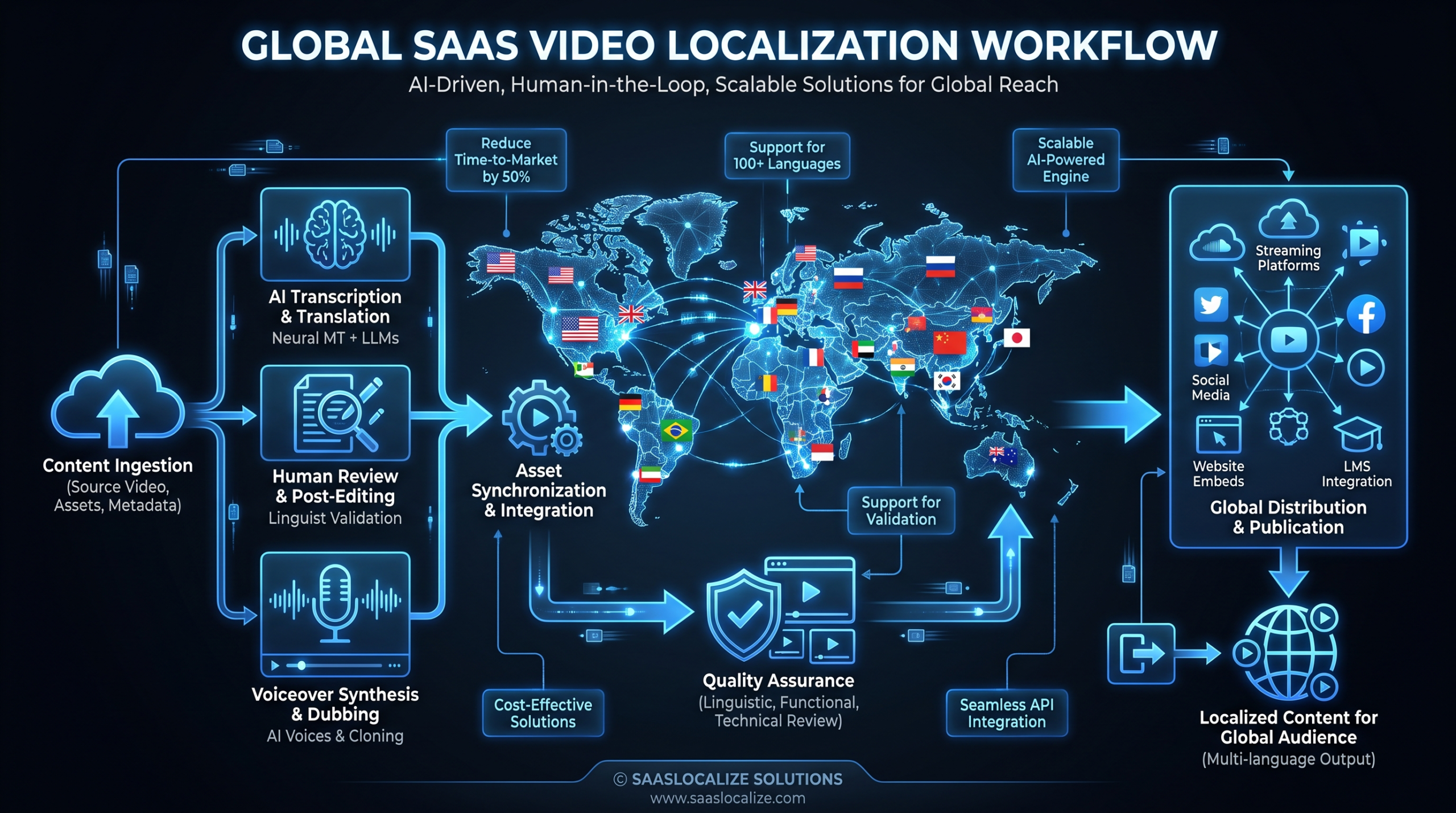
- A localization pipeline has five phases: source prep → translation → voiceover → captions → asset localization. Each phase has its own vendor ecosystem and cost structure.
- Per-language production costs range widely: subtitles-only typically runs $150–$500 per video; full dubbing per language commonly falls in the $600–$2,500+ range depending on duration and voice talent.
- Structure videos for localization from day one — avoid idioms, build in 15–20% speaking-time margin for dubbing, and keep on-screen text in editable layers.
- A dedicated SaaS video team reduces per-language cost through template reuse, pre-built localization workflows, and brand-familiar editors who don’t need to re-learn your style with each new language.
Table of Contents
- Why Video Localization Is Now a Revenue Priority
- Subtitle vs. Dubbing vs. Re-Shoot: The Real Trade-offs
- Which Markets Need What Level of Localization
- Building a Video Localization Pipeline
- Cost Benchmarks per Language and Format
- How to Structure Videos for Easy Localization
- Tools and Vendors for Video Localization
- How a Dedicated Video Team Reduces Per-Language Cost
- FAQ
Why Video Localization Is Now a Revenue Priority
Localization is no longer a nice-to-have for SaaS companies expanding internationally. The expectation from enterprise buyers and SMB decision-makers alike is that your product — and your content — speaks their language. Literally.
For Series B and C SaaS companies entering new geographies, the video library is often the bottleneck. You’ve invested heavily in product demos, onboarding tutorials, feature walkthroughs, and customer stories. The question isn’t whether to localize that library — it’s how to do it without rebuilding every asset from scratch.
The math makes a compelling case. Most of the cost in creating a product demo or explainer is upstream: scripting, filming or recording, graphics, and editing. Translation and voiceover — the localization layer — typically represents 15–35% of total production cost per language. That means a $4,000 product demo can be available in Spanish, German, and French for a fraction of what three separate productions would cost.
The challenge is workflow, not budget. Teams that haven’t built a localization pipeline end up with inconsistent subtitles, misaligned audio, and on-screen text that wasn’t designed to accommodate character-dense languages like German or Japanese. This guide is the operational playbook to avoid those failures — and to build a system that scales as you enter more markets.
“A video that converts at 4% in English and 0.3% in German isn’t a localization success story. It’s evidence that subtitles alone don’t meet the bar for markets that expect fully localized voice.”
For context on how video production investment varies by format and team model, our guide to SaaS video production covers the category-specific requirements that inform localization planning.
Subtitle vs. Dubbing vs. Re-Shoot: The Real Trade-offs
The first decision in any localization project is the format. These aren’t equally interchangeable — each has meaningful differences in cost, quality, and market reception.
Subtitles
Subtitles overlay translated text on the original video with the original audio intact. They’re the fastest and lowest-cost option — a professional subtitle file for a 5-minute video can be turned around in 24–48 hours at a fraction of dubbing cost.
The limitation is cultural. Subtitle reception varies dramatically by market. In the Netherlands, Nordics, and India, professional-quality subtitles are standard and fully accepted for B2B content. In France, Germany, Japan, and Brazil, subtitles on commercial software content — especially for enterprise sales — often signal that you haven’t fully committed to the market. If your competitors have localized voice and you have subtitles, that’s a conversion disadvantage, particularly in enterprise deal cycles.
Near-Sync Voiceover (Dubbing)
Dubbing replaces the original audio with a voice actor recording in the target language, synchronized to the video. For most SaaS video content — product demos, screen recordings, tutorial walkthroughs, feature overviews — the practical standard is near-sync voiceover: a professional voice actor records in the target language, timed to match the general rhythm of the original but without strict lip-sync requirements. This works well whenever the presenter isn’t on camera, or when screen recordings and motion graphics dominate the visual.
Tight lip-sync dubbing, which matches mouth movements precisely, is significantly more expensive and is primarily warranted for on-camera spokesperson content where the visual mismatch would be obvious.
Full Re-Shoot
Re-shooting video in a target language with a native presenter is the highest-investment option. It makes sense in specific scenarios: when the original video is heavily presenter-driven, when the target market is a top-tier strategic priority requiring a fully localized brand presence, or when content involves local pricing, market data, or region-specific product features.
For most SaaS localization programs, re-shoots are reserved for flagship brand content (an exec message, homepage hero video) while the broader library uses dubbing or subtitles.
Localization Format Comparison
| Format | Relative Cost | Turnaround | Best For | Weakest For |
|---|---|---|---|---|
| Subtitles only | $ | 24–48 hrs | Nordics, India, English-adjacent markets | France, Germany, Japan, Brazil |
| Captions + translated on-screen text | $$ | 2–4 days | Screen recordings, SaaS tutorials | On-camera spokesperson content |
| Near-sync voiceover (dubbing) | $$$ | 5–10 days | Product demos, animations, explainers | Tight lip-sync requirements |
| Tight lip-sync dubbing | $$$$ | 1–3 weeks | On-camera brand films, spokesperson videos | High-volume localization programs |
| Full re-shoot | $$$$$ | 2–6 weeks | Flagship brand content, market-specific variants | Tutorial libraries, feature walkthroughs |
Which Markets Need What Level of Localization
Not every market requires the same investment. Experienced international SaaS teams use a tiered approach based on buyer expectations, market size, and competitive dynamics in each region.
Tier 1: Full Localization Required
These markets have deep-rooted expectations for fully localized commercial content. Showing up with English audio and subtitles is a credibility penalty — it signals you haven’t made the commitment. Budget for professional dubbing at minimum, and re-shoots for flagship content where budget allows.
- Germany — Enterprise SaaS buyers are particularly exacting; German-language content is expected, not optional. Localization quality is scrutinized.
- France — Legal requirements exist for French-language content in some commercial categories; buyer preference strongly favors native voice regardless.
- Japan — Localization expectations are extremely high across all content formats. Poor or missing localization is a disqualifying signal in enterprise evaluations.
- Brazil (Portuguese) — The largest SaaS market in Latin America. Spanish is not a substitute. Brazilian Portuguese dubbing is the standard for content targeting enterprise buyers.
- South Korea — Rapidly growing SaaS adoption with strong localization expectations for Korean-language content.
Tier 2: Subtitles Plus Translated On-Screen Text
These markets consume English-language content regularly but engage more readily with localized text. High-quality subtitles and translated on-screen text (thumbnails, lower-thirds, UI callout annotations) are generally sufficient, with dubbing reserved for high-priority assets like product demos and conversion-focused videos.
- Netherlands and Belgium
- Nordics (Sweden, Denmark, Norway, Finland)
- Spain and Spanish-speaking Latin America — Subtitles are more accepted than in Brazil; Spanish-language audio adds meaningful lift for conversion-focused content
- Poland, Czech Republic, Romania
- Israel
Tier 3: English Content Accepted
These markets have high English proficiency among the buyer personas SaaS companies typically target. Localized content helps at the margin, but English-language content doesn’t materially disadvantage you in enterprise evaluations.
- Australia, New Zealand, Canada
- India — English is a prestige language in B2B contexts; localization into Hindi or regional languages is not expected at the enterprise level
- Singapore, Hong Kong
- UAE and Gulf region — Arabic localization for consumer content, but English-first for enterprise SaaS
Market Localization Priority Matrix
| Market | Recommended Format | Dubbing Expected? | Re-Shoot Priority |
|---|---|---|---|
| Germany | Full dubbing | Yes | High |
| France | Full dubbing | Yes | High |
| Japan | Full dubbing | Yes | High |
| Brazil | Full dubbing (PT-BR) | Yes | Medium |
| Spain / LATAM | Subtitles + near-sync VO | Recommended | Low |
| Netherlands, Nordics | Subtitles + translated on-screen text | Optional | Not needed |
| Poland, CEE | Subtitles | Optional | Not needed |
| India | Subtitles (optional) | No | Not needed |
Building a Video Localization Pipeline
A localization pipeline is a repeatable sequence of steps that transforms a finished English video into a localized version. Without a defined pipeline, localization becomes a one-off scramble for every video and every language — expensive, inconsistent, and impossible to scale.
Here’s the five-phase pipeline that SaaS content teams commonly implement once they’re entering more than two markets simultaneously:
Phase 1: Source Content Preparation
This phase happens before any translation work begins. The goal is to produce a “localization-ready” master — a version of the video with all assets organized for downstream use.
- Export a clean dialogue track — the original voice isolated from music and sound effects, so it can be replaced with dubbed audio without re-editing the full mix.
- Export an M&E track (Music and Effects) — the full audio mix minus the voice. This becomes the audio bed on which dubbed versions are built.
- Export editable text layers — so that on-screen text (lower-thirds, titles, UI annotations, benefit callouts) can be updated without re-rendering the full video.
- Create a time-coded transcript — marking each spoken segment with start and end timecodes. This becomes the source document for translation and the timing reference for voice recording.
Teams that skip this phase during original production typically spend 2–4 hours of extra editing per video recreating these assets retroactively. It’s worth building source prep into your original production checklist from day one.
Phase 2: Translation and Script Adaptation
This is where professional translation comes in — and where many teams underinvest. Machine translation (DeepL, Google Translate) has improved dramatically for European technical content, but it still requires human review for anything customer-facing. A native-speaking editor with software domain knowledge will catch idiom translation errors, formality register mismatches, and product terminology inconsistencies that machine translation misses.
For dubbing projects, the translated script must also be adapted for timing — a process called lip adaptation or timing adjustment. Spoken German tends to run 15–25% longer than English for the same content. French tends to run 10–20% longer. This expansion must be built into the translated script before voice recording begins, or the dubbed audio won’t fit the video. A translator who doesn’t understand this constraint will deliver a technically accurate script that’s practically unusable for dubbing.
Phase 3: Voiceover Recording and Audio Production
For dubbed versions, you’ll work with a voiceover agency or individual voice talent in each target language. Key considerations:
- Voice matching — The dubbed voice should match the energy and tone of the original, not just the content. A high-energy presenter dubbed by a low-energy voice actor will feel disconnected even if the translation is perfect.
- Technical spec alignment — Remote recordings should match the audio specification of your original (sample rate, bit depth, noise floor). Inconsistent audio quality across a library is a credibility signal that buyers notice.
- Bilingual QC review — Someone with target-language competence should review the synced audio in context before final delivery. Auto-sync tools produce good starting points; they don’t replace editorial judgment.
Phase 4: Caption and Subtitle Production
Professional caption files (SRT, VTT) should be produced for every video regardless of whether dubbing exists — both for accessibility compliance and because captioned videos consistently see higher engagement on hosted platforms. According to Wistia’s guide on closed captions and subtitles, captions improve viewer comprehension and watch time across virtually all content types.
Caption timing requires human editorial review. Auto-generated captions from YouTube or your video hosting platform are usable starting points, not finished deliverables. Line breaks, reading speed (targeting no more than 17 words per second for comfortable reading), segment boundaries, and proper noun formatting all need human judgment to get right.
Phase 5: Thumbnail and Visual Asset Localization
Thumbnails and chapter title cards often contain English text baked into the image. These need to be recreated with translated text, and the design must accommodate character density differences. German text is routinely 30–40% longer than English equivalents. Japanese and Chinese character sets require entirely different font stacks and spacing rules.
Maintaining editable templates (Figma, Canva, or After Effects) for all thumbnail variants from the start eliminates the need to rebuild assets from scratch for each language. This is one of the highest-leverage operational practices in a localization program — the upfront effort of templatizing pays back on every language you add.
Cost Benchmarks per Language and Format
Localization costs depend on video duration, format choice, and vendor selection. The ranges below reflect what SaaS teams commonly encounter when working with professional vendors — not lowest-cost freelancer platforms, and not enterprise production houses at full-service rates.
For context on how per-minute editing costs factor into total video economics, see our breakdown of video editing cost per minute.
Localization Cost Benchmarks by Format (Per 5-Minute Video)
| Format | Low Estimate | Typical Range | High Estimate | Key Cost Driver |
|---|---|---|---|---|
| Subtitles (1 language) | $80 | $150–$300 | $500 | Translator quality, review round |
| Near-sync voiceover (dubbing) | $400 | $600–$1,200 | $2,500+ | Voice talent, studio, sync editing |
| Tight lip-sync dubbing | $1,000 | $2,000–$4,000 | $8,000+ | Adaptation script, talent, re-edit |
| On-screen text localization | $100 | $200–$500 | $1,000 | Number of text layers, template availability |
| Thumbnail recreation | $50 | $100–$250 per variant | $500 | Template availability, design complexity |
These costs are per-language, per-video. For a SaaS company localizing a 15-video product library into three languages with subtitles plus translated on-screen text, the total investment typically falls in the $15,000–$30,000 range. For full dubbing into three languages, expect $25,000–$60,000 depending on video duration and vendor selection.
The good news: marginal cost per language drops as your library grows. Templates, established vendor relationships, and brand style guides that translators can reference all reduce rework and review cycles. Teams commonly find that by the fifth or sixth localization project, per-video costs in a given language are 25–40% lower than they were for the first.
Language-Specific Cost Factors
Some languages cost more to localize than others due to voice talent availability, translation complexity, and character set requirements:
- European languages (German, French, Spanish, Italian) — Well-established voice talent pools and translation services. Costs generally fall in the typical ranges above.
- Japanese and Korean — Higher cost due to specialized voice talent conventions, distinct audio mastering expectations, and complex on-screen text requirements. Expect 20–50% premium over European language rates.
- Arabic (right-to-left) — RTL text layout requires template redesign. On-screen text localization costs are higher. Voice talent availability and pricing vary significantly by dialect (Modern Standard Arabic vs. Egyptian vs. Gulf).
- Brazilian Portuguese vs. European Portuguese — These are distinct markets with distinct voice talent. A European Portuguese recording will be immediately noticeable — and not positively — to Brazilian buyers. Budget for separate talent in each.
How to Structure Videos for Easy Localization
The decisions you make during original production have direct downstream consequences for localization cost and quality. SaaS video teams that build localization-ready content from the start commonly report meaningfully lower total localization costs compared to teams that retrofit localization onto videos designed purely for English delivery.
Building for localization doesn’t require expensive reshoots or fundamental changes to production workflow. It requires a checklist of structural choices made at the scripting and production stage.
Language-Neutral Scripting
The biggest localization cost driver is idiomatic language that doesn’t translate. Phrases like “move the needle,” “drinking from a firehose,” “boil the ocean,” or “get all your ducks in a row” create real translation challenges. Literal translations are nonsensical; adapted translations require creative rewriting that changes length and rhythm, adding cost and review cycles.
Write scripts in plain, direct language. Prefer concrete verbs over idioms. Avoid cultural references that are specific to English-speaking markets — US sports metaphors, references to American political or cultural events, or humor that depends on wordplay in English. This isn’t about making scripts bland — it’s about making them structurally neutral so they adapt cleanly into target languages.
Build in Dubbing Time Margin
Many languages run longer than English when spoken. If your presenter delivers content at a natural pace with minimal pauses, there’s no room for a dubbed voice actor to match the rhythm without rushing. The result is either hurried dubbing that sounds unnatural, or audio that runs longer than the visual segments, creating timing mismatches.
Professional localization practice is to build 15–20% of empty space into English scripts — deliberate pauses after key points, visual transition moments, and segments where on-screen content carries the message without narration. This headroom gives voice actors what they need to deliver a natural-sounding performance in the target language without fighting the cut.
Keep On-Screen Text in Editable Layers
Every text element appearing on screen — lower-thirds, chapter titles, UI callout labels, benefit bullet points, animated headers — should live in an editable layer in your project file. Text burned into the video export requires a partial or full re-render to localize. Text in a live layer can be localized by updating a field and re-exporting only the affected segment, often saving hours per language for text-heavy tutorial and demo videos.
This single practice — maintaining project files with live text layers through to delivery — is one of the most operationally impactful changes a SaaS video team can make to reduce localization friction.
Font and Character Set Planning
The typeface that works for English may not support Japanese, Korean, Arabic, or even some extended European characters. Specify fallback fonts in your design system before production begins. Font licensing for Unicode-range coverage can be a hidden cost when you first encounter it mid-localization. Establish this foundation early to avoid last-minute design compromises.
Tools and Vendors for Video Localization
The localization toolchain has evolved significantly. AI-powered translation and synthetic voiceover have lowered the floor on per-language cost, while professional human talent remains the standard for customer-facing enterprise content. The practical approach is to match tool to use case rather than applying one solution across the board.
Translation Tools
- DeepL Pro — Widely considered the highest-quality machine translation option for European languages, particularly German, French, Dutch, Polish, and Spanish. API access enables integration into localization workflows for high-volume teams.
- Human translation services — Platforms such as ProZ, One Hour Translation, and specialist SaaS/tech translation agencies provide human review and domain-specific accuracy. Human review is still required for any customer-facing content, regardless of machine translation quality.
Voiceover and Dubbing Platforms
- ElevenLabs, Murf AI, HeyGen — AI voice synthesis platforms producing near-human quality voiceover for tutorial and screen-recording content at significantly lower cost than human voice actors. Quality varies by language and use case; human talent remains preferable for on-camera or flagship content.
- Voices.com, Voice123 — Freelance voice talent marketplaces with professional actors in most major languages. Good for sourcing one-off projects; build a preferred vendor roster over time as you identify talent that matches your brand’s energy.
- Iyuno, ZOO Digital, BTI Studios — Full-service dubbing and localization studios handling everything from script adaptation through final delivery. Positioned for enterprise-scale programs; pricing reflects full-service scope.
Caption and Subtitle Tools
- Rev.com — Human transcription and subtitle services with predictable turnaround. Accurate for technical SaaS content when reviewed by a subject matter expert for terminology.
- HappyScribe — Subtitle and transcription platform with automated plus human hybrid workflow. A practical option for SaaS teams managing multiple languages at volume.
- Kapwing, Subly — Lighter-weight subtitle tools suited for social media and shorter-form content.
Wistia’s recommendation on captioning (covered in their closed captions and subtitles guide) is consistent with what most SaaS video teams find in practice: adding captions is one of the highest-ROI optimizations for hosted video, both for accessibility and engagement.
Dedicated SaaS Video Teams with Localization Capability
For SaaS companies localizing more than 3–5 videos per month across multiple languages, working with a dedicated video team or full-service agency is significantly more efficient than managing a fragmented vendor stack. The operational overhead of briefing, reviewing, and QC’ing across five separate vendor relationships compounds at scale.
SaaS Video Teams: Localization Capability Comparison
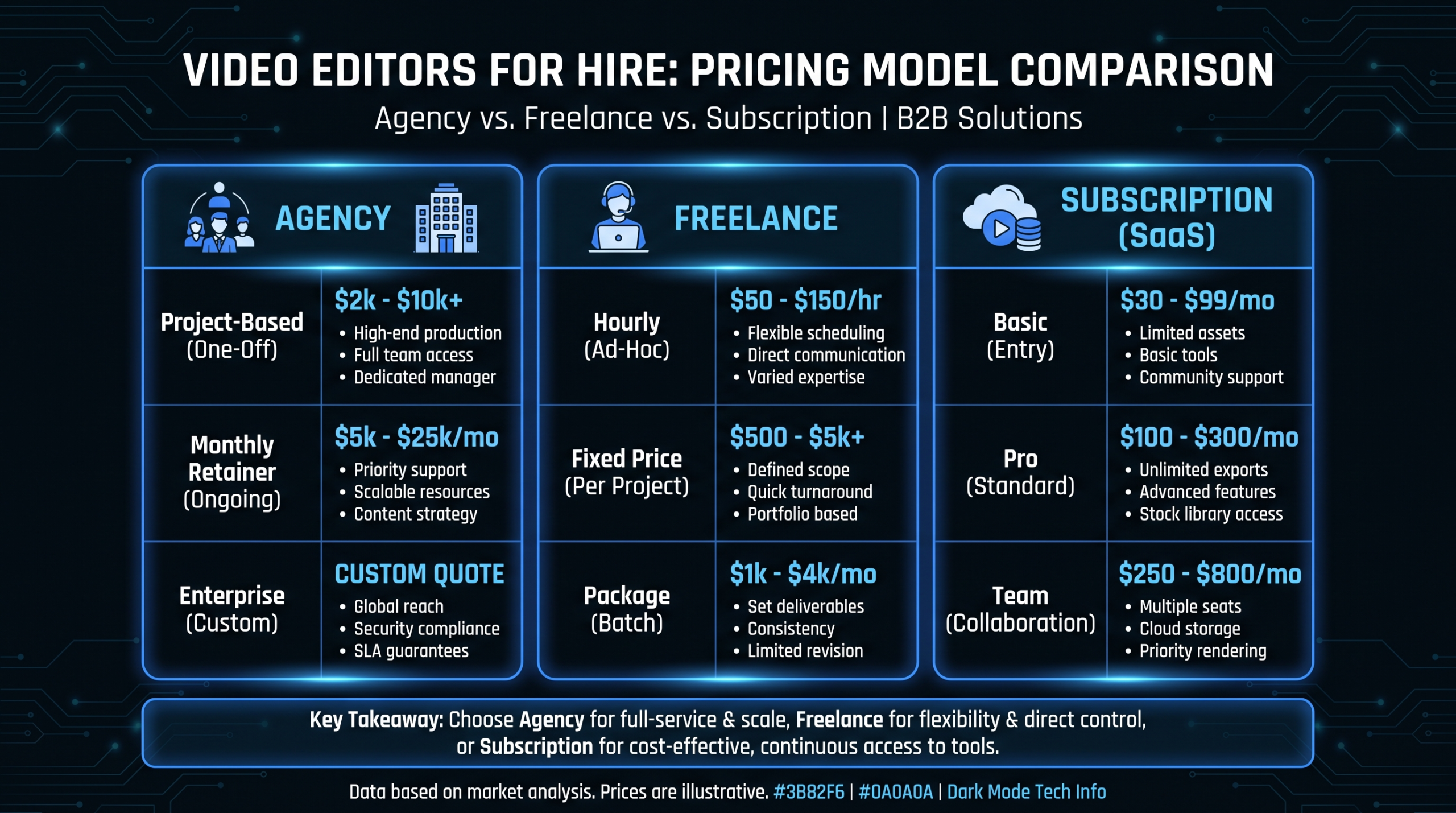
| Provider | Localization Support | SaaS Focus | Model | Starting Price |
|---|---|---|---|---|
| Video Editing Company (VEC) | Full pipeline: subtitles, near-sync dubbing, on-screen text, thumbnail localization | SaaS-exclusive | Dedicated team (Growth $5K/mo, Core $9.5K/mo, Scale $16K/mo) | $5,000/mo |
| Increditors | Subtitles, voiceover coordination, on-screen text localization; manages localization vendors | SaaS, YouTube, Education, Finance | Custom retainer; dedicated pod (Sr. editor + Jr. editor + PM + CD) | ~$2,500/mo |
| Iyuno / ZOO Digital | Full enterprise dubbing and localization pipeline | Broadcast and film focus | Per-project or volume contracts | Varies (enterprise) |
| Fiverr Pro / Upwork teams | Highly variable; depends on individual freelancers | Not specialized | Per-project | $50–$500 per video |
| Internal team build | Full control but requires hiring, management, and vendor relationship overhead | N/A | Headcount | $80K–$200K+/yr per editor |
VEC’s dedicated team model stands out specifically for SaaS localization because the same team handles both the original production and the localized versions. They already know your brand, your product terminology, your motion graphics system, and your style guide. Localizing a video into three languages with the team that built the original is faster and more consistent than handing off to a separate vendor for each language who needs to be briefed on your brand from scratch.
Increditors offers a credible alternative at a lower entry price, with dedicated editor pods that serve a broader range of clients including YouTube creators, education brands, and finance companies. Their custom retainer model works well for teams that want brand-familiar editors without the SaaS-exclusive positioning. Pros: strong editor teams, proven track record of doubling channel performance for clients, flexible retainer structure. Cons: pricing isn’t publicly tiered (custom quotes required), and their broader client base means your account shares editorial attention with non-SaaS work. Reach them at [email protected].
How a Dedicated Video Team Reduces Per-Language Cost
The economics of localization improve dramatically when your editing team is continuous rather than project-based. Here’s why the math favors a dedicated team arrangement for any SaaS company localizing more than a handful of videos per quarter.
Template Reuse Compounds Over Time
The first time you localize a product demo, your team must build: a translated subtitle file, an adapted voiceover script, a re-edited audio track, and localized thumbnail variants. That setup work is real cost. By the third time the same team localizes a product demo for the same SaaS brand, many of those workflows are systematized: templates exist, vendor relationships are in place, and the team knows exactly which assets need localization and which don’t.
Teams working with a dedicated video partner commonly find that per-language localization cost drops meaningfully between the first localization project and the fifth, purely from process efficiency — not from cutting quality. The per-language cost curve tends to flatten out after 3–6 projects as templates and vendor relationships stabilize.
Parallel Production Is Feasible
A dedicated team with multiple editors can run localization tracks in parallel with new content production. While one editor finishes an English master, another can be localizing a previous video into German. This isn’t feasible with a per-project vendor model where each engagement requires a fresh brief and a sequential handoff.
This parallelization matters most when you’re producing 4–8 videos per month and need them localized within 1–2 weeks of the English master. A per-project approach serializes that work; a dedicated team approach runs it concurrently.
Brand Consistency Across Languages
Localized content that sounds technically accurate but looks visually inconsistent with the English master creates a fractured brand experience. Font handling, lower-third positioning, animation timing, audio EQ, and color treatment all need to match across language variants. A team that knows your brand deeply — as a dedicated team does after 60–90 days of consistent work — maintains that consistency without exhaustive QC review on every localized deliverable.
If you’re currently managing localization ad hoc across a mix of freelancers and vendors, it’s worth mapping what a structured program would look like. Our guide to how to outsource video editing covers the broader decision framework, including when to centralize editing work under one team versus maintaining a distributed vendor approach.
The Cost Math for a Three-Language Program
Consider a SaaS company producing 6 new English videos per month and needing to localize each into German, French, and Spanish (near-sync dubbing for DE/FR; subtitles only for ES):
Monthly Localization Cost: Per-Project vs. Dedicated Team
6 videos × DE/FR dubbing ~$800–$1,200 each + ES subtitles ~$200 each
Covers original production + localization; team already knows your brand and templates
At the Core plan level, localization of 3 languages across 6 monthly videos can be cost-neutral or cost-positive vs. freelancer alternatives — while delivering better consistency, faster turnaround, and no vendor management overhead.
The actual break-even depends on your video length, complexity, and whether templates are already in place. But the principle holds: volume favors dedicated teams, and localization amplifies that advantage because setup costs are absorbed across an ongoing relationship rather than re-incurred on every project.
For teams at Series B or C stage where international revenue is a stated goal for the next 12 months, the question isn’t whether to localize video — it’s whether to build that localization program as a structured operation from the start or piece it together reactively. The reactive approach costs more, delivers less consistency, and is harder to scale. See what a dedicated SaaS video team plan looks like at each tier.
Frequently Asked Questions
Do I really need full dubbing, or can I get away with subtitles in Germany and France?
For most SaaS companies at Series A, subtitles get you in the door for German and French markets. But teams that have tested both consistently find that dubbed content outperforms subtitled content in these markets — particularly for product demos and conversion-focused videos used in sales cycles. If you’re running paid campaigns or actively prospecting enterprise accounts in Germany or France, dubbing the core product demo is one of the highest-ROI localization investments you can make. For tutorial libraries and onboarding documentation, subtitles are generally sufficient.
Can AI voice synthesis replace human voice actors for video localization?
For tutorial content, internal training videos, and lower-stakes customer-facing assets, AI-generated voiceover (via tools like ElevenLabs or Murf AI) is increasingly viable and meaningfully cheaper than human talent. For flagship content — product demos used in enterprise demos, brand films, case study videos — human voice talent still sets the quality bar. A practical hybrid approach: use AI voice for your tutorial library localization (fast, affordable, scalable) and invest in human voice talent for the conversion-critical videos in your library.
What’s the right order to localize a SaaS video library?
Prioritize by revenue impact, not by video count. Your primary product demo, core explainer video, and top-of-funnel brand videos should be localized first because they have the highest conversion leverage. Tutorial and onboarding content can follow once you’ve proven traction in the market with localized top-of-funnel content. Within that, prioritize languages by market size and competitive context: if you’re entering Germany and a key competitor already has German-language video content, German localization is a competitive priority, not just a nice-to-have.
Can I use the same Spanish translation for Spain and Latin America?
For subtitles and written content, a neutral Spanish (sometimes called “Latin American neutral” or “international Spanish”) can work reasonably well across markets — it’s a common compromise for SaaS companies that want to cover the Spanish-speaking world without two separate translation passes. For voiceover and dubbing, regional accent matters more: a Castilian Spanish accent will sound noticeably foreign in Mexico or Colombia, and vice versa. If one Spanish-language market represents significant revenue opportunity, invest in regionally appropriate voice talent for that market.
How do I measure the ROI of video localization?
The clearest measurement framework is comparing conversion and engagement metrics on the same asset before and after localization in a specific market. Use your video hosting platform (Wistia, Vidyard, or Loom) to track play rate, watch time, and CTA click-through rate by viewer geography. If a product demo in Germany sees a 15% play rate on the German version versus a 4% play rate on the English version, that differential is your signal. Connect it to pipeline by tagging localized video views in your CRM and tracking deal progression for contacts who engaged with localized content. For further context on video engagement benchmarks, HubSpot’s video marketing resource hub covers measurement frameworks commonly used by B2B teams.
Ready to Scale Video Across Global Markets?
VEC’s dedicated SaaS video teams handle original production and localization under one roof — so your German, French, and Spanish versions are built by a team that already knows your brand. Plans start at $5K/month with a 90-day guarantee: double your video output or month four is free.
Book a Free Strategy Call See Plans & Pricing