Video Ads for SaaS: Formats That Lower CAC
TL;DR
- Demo snippets and problem/solution videos consistently outperform static ads across LinkedIn, YouTube, and Meta for B2B SaaS.
- Hook + benefit within the first 3–5 seconds is non-negotiable; most platform algorithms penalize early drop-off heavily.
- Repurposing existing long-form content (webinars, demos, case study interviews) into ad-ready cuts is the fastest way to build creative volume without proportionally increasing spend.
- Static vs. video CAC gap: teams commonly report 20–40% lower CPL from video creatives on identical audiences.
- Dedicated video editing teams eliminate the creative bottleneck that kills ad performance at scale.
Table of Contents
The conversation about SaaS video ads usually starts in the wrong place — with production budgets and platform spend. The real starting point is customer acquisition cost. Every dollar you spend acquiring a customer has to close a gap between "never heard of you" and "ready to buy." Video, when executed correctly, closes that gap faster and more efficiently than any other creative format in B2B paid media.
This guide is written for the Head of Content or VP Marketing at a Series A–C SaaS company who is already running paid acquisition and wants to understand which video formats actually move CAC, how to structure creative testing, and how to build a sustainable production system that doesn't become a bottleneck.
No abstractions. No "video is the future" positioning. Just the mechanics of what works, why it works, and how to operationalize it at scale.
Why Video Ads Lower CAC for SaaS
SaaS products are inherently harder to explain than physical goods. You're selling an outcome that requires the buyer to imagine a workflow they've never experienced. Static creative — a headline, a screenshot, a benefit bullet — asks the viewer to do significant cognitive work. Video does that work for them.
Three mechanisms explain why well-constructed video ads produce lower CAC:
1. Higher Information Density Per Second
A 30-second demo snippet can convey product UI, workflow speed, and user emotion simultaneously. The equivalent in static form requires a carousel with 5–8 frames and demands sequential attention the viewer may never give you. Platforms that reward engagement (all of them) respond to this by showing your ad to more people at the same CPM — effectively lowering your cost per qualified impression.
2. Pre-Qualification at Creative Level
A strong video ad pre-qualifies intent before the click. When a prospect watches 15 seconds of your product in action and clicks through, they arrive at your landing page with a baseline of product understanding that converts at higher rates. Teams commonly report that video-driven traffic converts on-page 15–30% better than static-driven traffic to identical landing pages — meaning the same ad spend generates more pipeline.
3. Emotional Anchoring
B2B purchases are not purely rational decisions. The VP of Marketing who champions your tool in a committee review does so partly because of how they feel about the brand. Video is the most efficient format for building that emotional connection in paid media — tone, pacing, music, and visual style all communicate trust and competence in ways text cannot.
The result: when you move from static-only to a balanced static + video creative mix, average CPL drops. The degree depends on vertical, audience, and creative quality — but the direction is consistent.
The 5 Video Ad Formats That Work
Not every video performs as an ad. Many SaaS teams make the mistake of taking long-form content (a 45-minute webinar, a 10-minute product walkthrough) and running it as paid creative. That's not a video ad — it's a video that happens to be in an ad placement. The formats below are engineered for paid performance.
Format 1: Demo Snippets (15–45 seconds)
The single highest-performing format for mid-funnel SaaS paid acquisition. A demo snippet shows the product solving a specific, recognizable problem in real time. Key characteristics:
- Problem-first framing: "Struggling to track which deals are about to slip?" — then show the product solving exactly that.
- One workflow, not everything: Do not try to show the full product. Show one use case, one outcome, one "aha" moment.
- Cursor movement matters: Real UI interaction — mouse movement, actual clicks — builds credibility that polished animations often don't.
- Optimal length: 15–30 seconds for top-of-funnel cold audiences; up to 45 seconds for retargeting audiences who've already visited your site.
Format 2: Testimonial Cuts (20–60 seconds)
Social proof in motion. A 30-second testimonial clip from a recognizable company in your ICP outperforms written testimonials by a wide margin in paid placements. What makes a testimonial ad work:
- Specificity, not superlatives: "We reduced onboarding time from three weeks to four days" converts better than "this product changed our business."
- Role-matched speakers: If your ICP is Head of RevOps, use a Head of RevOps in your testimonial — not a CEO or a junior analyst.
- No talking heads without context: B-roll of the product in use, or the speaker's actual work environment, keeps engagement higher than a static headshot with a quote overlay.
Format 3: Problem/Solution Stories (30–90 seconds)
The classic narrative arc applied to SaaS. Act 1: relatable pain state ("your sales reps are wasting 2 hours a day on manual data entry"). Act 2: product as the turning point. Act 3: outcome state ("that time goes back to selling"). This format works particularly well on LinkedIn and YouTube where audiences are open to slightly longer narrative content.
The critical failure mode: making Act 1 too long. Spend no more than 20–25% of the runtime on the problem. Buyers already know they have the problem — they need the solution.
Format 4: Feature Highlight Videos (15–30 seconds)
A tight, benefit-led demonstration of one specific feature. These are especially effective for retargeting audiences who've already been to your pricing or feature pages — they know the product category, so you're competing on capability differentiation rather than awareness.
The structure: name the feature, show it working, state the benefit in one sentence. No intro, no outro, no brand positioning. Get in, prove the feature, get out.
Format 5: Social Proof Compilation (30–45 seconds)
A montage of proof — customer logos, G2/Capterra ratings, quick quote overlays, metric callouts ("4,200 companies. $2.4B in pipeline managed."). These work well for audiences in the final consideration stage who are comparing you against 2–3 alternatives. They don't need to be convinced video is good; they need to be convinced you specifically are safe to choose.
Video Ad Format Performance by Funnel Stage
| Format | Best Funnel Stage | Optimal Length | Primary Goal |
|---|---|---|---|
| Demo Snippet | Mid-funnel (warm) | 15–30 sec | Product consideration |
| Testimonial Cut | Mid-to-lower funnel | 20–60 sec | Trust + social proof |
| Problem/Solution Story | Top-of-funnel (cold) | 30–90 sec | Awareness + resonance |
| Feature Highlight | Retargeting | 15–30 sec | Differentiation |
| Social Proof Compilation | Lower funnel | 30–45 sec | Conversion confidence |
Platform-Specific Best Practices
The same video will perform differently across platforms not because of targeting, but because of context. Understanding where your buyer's head is when they encounter your ad determines how to format, pace, and frame the creative.
LinkedIn's ad inventory is expensive — CPMs for B2B SaaS audiences routinely run $50–150+ per thousand impressions. That makes every second of watch time consequential. What consistently works on LinkedIn:
- Square (1:1) or vertical (4:5) formats take up more feed real estate than 16:9 on mobile, which is where most LinkedIn consumption happens.
- Text on screen from second zero. 80% of LinkedIn videos are watched without sound. Every critical message needs to be readable, not just audible.
- Lead with the job title, not the product. "For Revenue Operations leaders..." creates instant ICP resonance that "Introducing [Product]..." does not.
- LinkedIn Lead Gen Form ads paired with video consistently outperform click-to-landing-page video ads for CPL — the friction reduction offsets the lower intent signal.
- Optimal video length: 15–30 seconds for awareness/lead gen; up to 2 minutes for thought leadership content aimed at retargeting audiences.
YouTube
YouTube is the only platform where buyers will voluntarily spend 5–15 minutes with your content before they've ever visited your website. It rewards depth in ways LinkedIn and Meta don't.
- Skippable in-stream ads (TrueView): You only pay when someone watches 30+ seconds or to completion. This means you're paying for engaged viewers — structure your opening 5 seconds as if they're all you get, and the next 30+ seconds for people who chose to stay.
- The 5-second hook is a hard constraint. On skippable ads, you have exactly 5 seconds before the skip button appears. Put your most credibility-building element first: a recognizable customer logo, a specific result number, or a visual hook that makes skipping feel like a mistake.
- Non-skippable bumper ads (6 seconds) work best as frequency plays in conjunction with longer content — they're not standalone performers, they're reinforcement.
- Product demo content performs well as YouTube discovery ads — these appear in search results and suggested video sidebars, reaching buyers actively researching your category.
Meta (Facebook + Instagram)
Meta's strength for B2B SaaS is audience scale and creative learning speed — you can cycle through creative variants faster than on any other platform. Key considerations:
- Stories and Reels formats (9:16 vertical) outperform feed placements on CPM and engagement rate for most B2B SaaS audiences, though the creative production requirements differ.
- Meta's algorithm rewards early engagement signals. Hook performance in the first 3 seconds — measured by 3-second video plays as a percentage of impressions — is the primary quality signal that drives distribution.
- Retargeting on Meta is undervalued by SaaS teams. Website custom audiences (people who visited your pricing page or demo request page) are high-intent and convert at significantly lower CAC than cold targeting. Video testimonials and feature highlights on these audiences often produce the best CAC numbers in a SaaS media mix.
- Keep primary text above the fold. On most mobile screens, only the first 1–3 lines of ad copy are visible without expansion. Your hook copy should stand alone without requiring a "see more" click.
Hooks and Length Data
No part of a video ad has a greater impact on performance than the first three seconds. Understanding what makes a hook work — and what common structures underperform — is foundational to building effective SaaS video creative.
What Makes a Hook Work
Effective video ad hooks share three characteristics: they create a pattern interrupt (something visually or verbally unexpected), they address a recognized pain point immediately, and they imply that staying will resolve tension. The weakest hooks are logo reveals and brand intros — these are optimized for your internal stakeholders, not for the viewer's attention.
Hook structures that tend to perform in B2B SaaS paid media:
- The number hook: "Your reps spend 11 hours a week on tasks [Product] eliminates." — Specificity creates credibility and curiosity simultaneously.
- The question hook: "What happens to your pipeline when your CRM data is six months out of date?" — Raises stakes for buyers who recognize the problem.
- The contrast hook: Split-screen of messy spreadsheet vs. clean dashboard — visual demonstration of before/after without a word of copy.
- The social proof hook: Open with a recognizable customer logo or a metric ("4,100 SaaS teams trust [Product]") — borrows credibility before asking for attention.
Length Guidance by Platform and Objective
Video Length by Platform and Campaign Objective
| Platform | Objective | Recommended Length | Notes |
|---|---|---|---|
| Lead generation | 15–30 sec | Lead Gen Form reduces click friction | |
| Brand awareness | 30–90 sec | Story-format performs well | |
| YouTube | Skippable in-stream | 30–120 sec | First 5 sec must earn the skip |
| YouTube | Bumper (non-skip) | 6 sec max | Best as frequency/retargeting layer |
| Meta Feed | Conversion | 15–30 sec | Front-load benefit, CTA by sec 15 |
| Meta Stories/Reels | Awareness/retargeting | 7–15 sec | Full-screen vertical, native feel |
Research from Wistia's State of Video report consistently shows that engagement rates decline sharply after two minutes for most video content. For paid ad placements, the dropoff begins much earlier — plan creative around the assumption that you have 8–15 seconds of reliable attention on most platforms.
A/B Testing Framework for Video Ads
Most SaaS paid media teams test video in an ad hoc way — run a video, see if it does better than the static, declare victory or defeat. A structured framework produces compounding insights and prevents you from drawing the wrong conclusions from individual creative tests.
What to Test and When
Test variables in this order of priority, because each layer informs the next:
- Hook (first 3 seconds): Test two different opening approaches against the same core video content. This tells you what problem framing or visual opener resonates with your audience before you invest in full creative variants.
- Format: Once you know your hook direction, test which format (demo snippet vs. problem/solution story vs. testimonial) performs best for each campaign objective and audience segment.
- Length: Take your winning format and test a condensed version. Many teams find that cutting a 45-second video to 22 seconds improves both CPL and CTR without sacrificing conversion quality.
- CTA: Test "Book a Demo" against "Watch a 2-Minute Overview" against "Start Free" — the CTA framing affects who clicks and what intent they arrive with. Lower-friction CTAs may increase click volume but decrease conversion rate, so measure through to pipeline, not just CPL.
Test Design Rules
- Isolate variables. Never test hook AND length at the same time — you won't know which change drove the result.
- Statistical significance before decisions. A 100-click sample is not meaningful. Set minimum thresholds (at least 300–500 impressions at a minimum, preferably 1,000+ for reliable directional data) before reading results.
- Test to the metric that matters. CPM and CTR are leading indicators, but pipeline generated or demo requests are the real measures. A video with a lower CTR but higher conversion rate may produce better CAC than the click-volume winner.
- Maintain a creative log. Document every test, the hypothesis, the result, and the learning. This institutional knowledge compounds over time and prevents your team from re-testing the same hypotheses with different creative.
Velocity Matters
The teams that consistently lower CAC through video testing are the teams that can ship creative quickly. If it takes 3 weeks to produce one video variant, you'll test two concepts per quarter. If you can produce a variant in 3–5 days, you'll test 15–20 concepts per quarter. The learning rate difference is not linear — it's structural. This is where the production bottleneck becomes a CAC problem.
Repurposing Existing Content Into Ads
Most Series A–C SaaS companies have more raw material for video ads than they realize. The bottleneck is editing capacity and strategic direction, not original content. A systematic repurposing framework converts existing assets into a diverse ad creative library without starting from scratch.
The Four Asset Categories to Audit
1. Recorded demos and sales calls. Your AEs are giving live product demos every week. With customer permission, these recordings are a gold mine. A well-edited 30-second snippet from a demo call — showing the product solving a recognizable problem — is often the most authentic and highest-converting creative format because it features real usage, real reactions, and real questions. The editing challenge is identifying the right 30-second window and cutting cleanly.
2. Webinar recordings. Every webinar you've ever hosted is a repository of potential ad content. Segments where a panelist describes a common customer pain point, or where you demonstrate a product capability, can be extracted and repackaged as 15–45 second standalone clips. The production requirement is minimal — clean cuts, captions, and sometimes a lower-third for speaker identification.
3. Customer testimonial interviews. If you've recorded case study interviews, the raw footage contains far more usable content than ever appears in the finished case study video. A 20-minute interview might yield 4–6 distinct clips, each focused on a different benefit or use case. These can run as standalone testimonial ads or be assembled into social proof compilations.
4. Long-form product content. Tutorial videos, feature announcement recordings, and product onboarding content can all be cut into format-specific versions. A 10-minute product walkthrough becomes a 30-second demo snippet with the right edit. The key is cutting to the specific moment of value, not the full explanation arc.
For a deeper look at how SaaS companies structure their video content programs, see our guide to SaaS video production.
The Repurposing Multiplier
A single well-produced customer case study interview (30–60 minutes of raw footage) can produce:
- 1 × 2-3 minute hero testimonial video
- 3–4 × 30-45 second testimonial ad clips
- 1 × social proof compilation with 5+ customers
- 6–10 × 15-second quote clips for Stories/Reels
- Audio for podcast or transcript for blog content
That's 12–18 distinct content assets from a single recording session. Teams that build this kind of systematic repurposing workflow dramatically reduce their cost-per-asset — and by extension, their cost-per-ad-variant, which directly feeds into the testing velocity that lowers CAC.
If you're considering bringing in an external team to handle the editing work, our guide to how to outsource video editing covers the key decisions and workflow structures.
CAC Benchmarks: Video vs. Static
The honest answer on CAC benchmarks is that they vary significantly by vertical, audience size, bid strategy, and creative quality — and any specific number you read in a blog post should be treated as directional, not prescriptive. That said, patterns from across SaaS paid media programs are consistent enough to be useful for planning purposes.
General Patterns in Video vs. Static Performance
Video vs. Static: Typical Performance Differentials in B2B SaaS Paid Media
| Metric | Static Creative | Video Creative | Typical Difference |
|---|---|---|---|
| Click-Through Rate (CTR) | Baseline | +20–60% | Video higher on most platforms |
| Cost Per Click (CPC) | Baseline | Varies widely | Often similar or lower due to higher CTR |
| Landing Page Conversion Rate | Baseline | +15–30% | Video-primed visitors convert better |
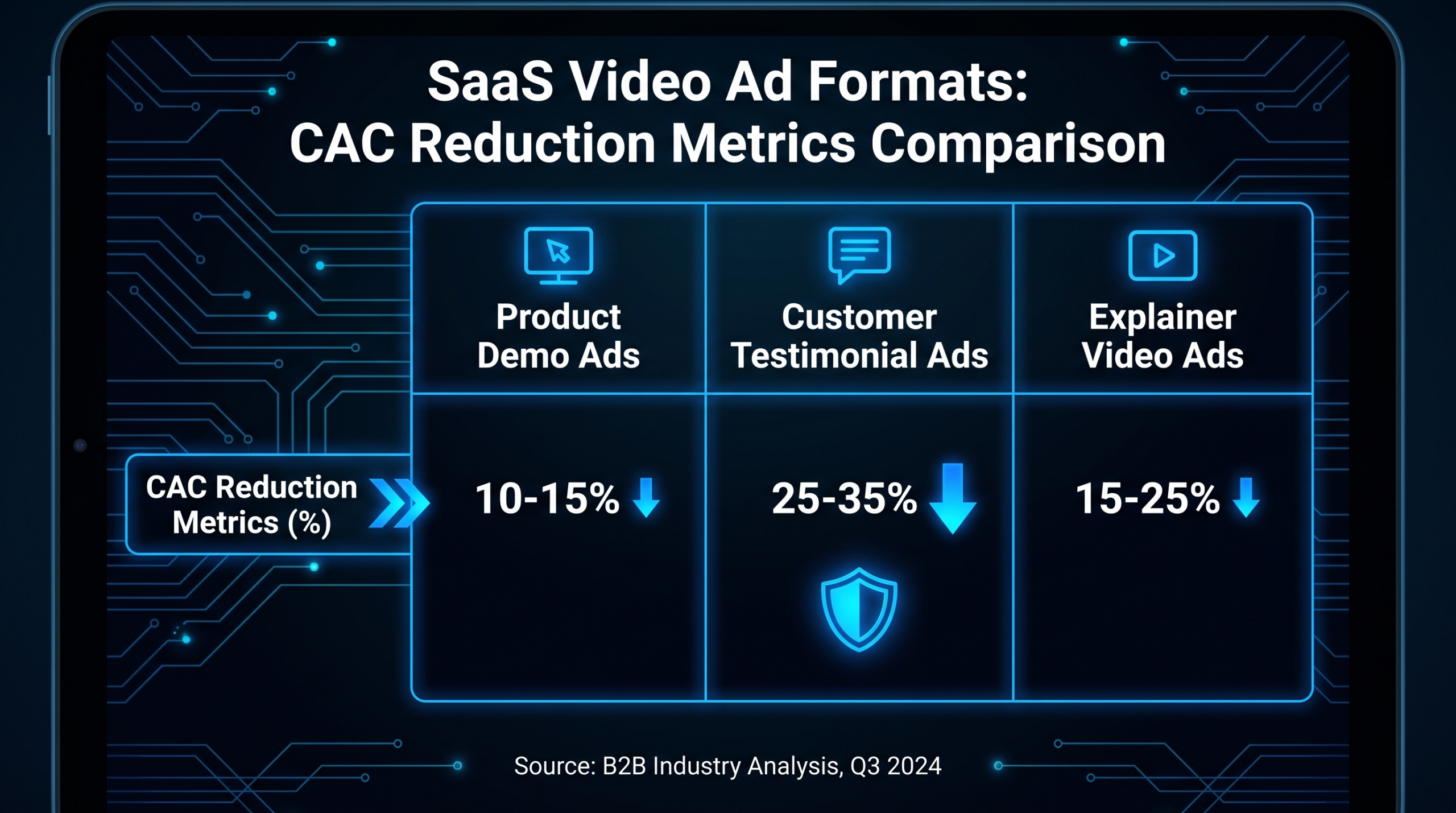
| Cost Per Lead (CPL) | Baseline | 20–40% lower | Teams commonly report this range |
| Lead-to-Demo Rate | Baseline | +10–25% | Better pre-qualified intent |
| Creative Fatigue Rate | Faster | Slower | Video audiences take longer to saturate |
The CPL reduction figure is the most relevant for CAC purposes. A 25% reduction in CPL across your paid acquisition channels, holding lead quality and sales conversion constant, compounds significantly over a quarter. A team spending $50K/month on paid acquisition could expect to generate meaningfully more pipeline at the same budget — or achieve the same pipeline at lower spend — once video creative reaches testing maturity.
Where the Math Breaks Down
Video only lowers CAC when creative quality is above a minimum threshold and when production velocity allows meaningful testing. Poorly produced video — bad lighting, no captions, unclear hook, weak CTA — can perform worse than a strong static. And a single well-produced video that never gets tested or iterated will hit creative fatigue and decline. The structural investment required to realize the CAC advantage is a consistent production system, not a one-time video project.
Understanding what goes into producing these assets at scale helps with budgeting — our breakdown of product demo video production covers what to expect for one of the most common ad formats.
Why a Dedicated Video Team Changes the Equation
The consistent finding among SaaS growth teams that scale video advertising successfully is that the production bottleneck is the primary constraint — not creative strategy, not budget, not audience quality. When it takes weeks to produce a single video variant, every other part of the system is underutilized.
The Creative Bottleneck Problem
A typical Series B SaaS company might have one internal video editor, shared with demand gen, product marketing, and sales enablement. Ad creative competes for that editor's time against tutorial videos, onboarding content, and conference presentations. When campaign performance drops and you need 4 new creative variants by next week, the bottleneck becomes the CAC problem.
Dedicated video editing teams solve this structurally rather than organizationally. Instead of adding headcount (with all the recruiting, management, and benefits overhead that implies), you access a matched team — senior editor, junior editor, project manager, creative direction — that is exclusively focused on your account and operates as an extension of your marketing function.
What "Dedicated" Means in Practice
With a dedicated team model, the operational cadence changes. Your team knows your brand guidelines, your product interface, your customer personas, and your ad account structure. Briefing a new creative variant takes minutes, not hours, because you don't explain context every time. Turnaround on a 30-second ad cut from existing footage typically runs 24–48 hours rather than 1–2 weeks. That speed unlocks the testing velocity that compounds into lower CAC over a quarter.
VEC (Video Editing Company) operates on exactly this model — Growth, Core, and Scale plans that give SaaS marketing teams a dedicated editing pod with a guarantee of double video output in 90 days or month 4 free. The economics are designed around the thesis that consistent creative volume and testing velocity is what drives paid media performance, not individual hero videos. See VEC's pricing plans for specifics on team structure by tier.
Build vs. Buy: The Real Cost Comparison
The comparison point for a dedicated video team isn't a per-project agency — it's the cost of building in-house capacity to match the same output. A senior video editor in a major US market commands $80–120K in base salary, before benefits, equipment, software licenses, and management time. A mid-level hire with SaaS-relevant experience is $60–80K. A team capable of producing 15–20 quality ad variants per month runs $200K–300K+ fully loaded — and that's before accounting for the fact that in-house editors often lack the specialized experience of working exclusively on paid ad creative.
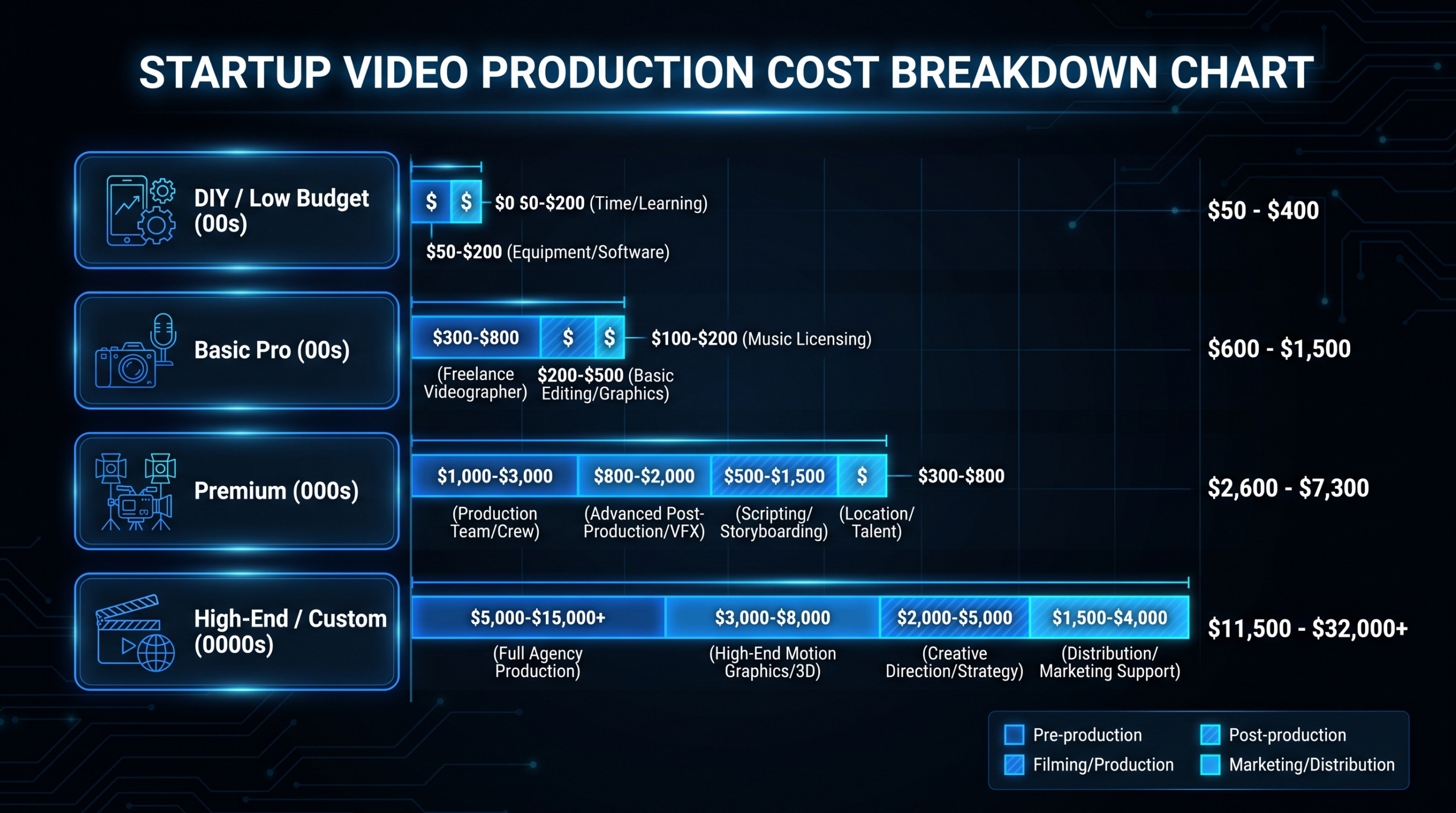
Dedicated team arrangements with agencies like VEC and Increditors (which offers similar dedicated editor pod models with senior editor, junior editor, PM, and creative director) typically run $5K–16K/month depending on output volume and complexity — a fraction of the in-house equivalent, with no recruiting risk and no single-person dependency when an editor leaves. Increditors focuses on premium full-service execution with custom retainers that reportedly run around $2.5K–12K+/month; worth evaluating if you want a provider comparison for your leadership team.
The Output Guarantee as a Risk Reducer
One of the structural advantages of working with a dedicated team is the predictability of output. When you know you'll have 12–20 edited video assets per month — consistently, on schedule — you can build your ad testing calendar around that cadence rather than scrambling when production falls behind. That predictability is what allows a systematic A/B testing framework to function, because you always have the next variant ready.
For context on how video programs are structured at scale, see our how it works page or browse customer case studies from teams that have built this kind of system.
Frequently Asked Questions
Which video ad format produces the lowest CAC for B2B SaaS?
Demo snippets (15–30 seconds showing the product solving one specific problem) consistently produce strong CAC performance for mid-funnel audiences. However, the "best" format depends on funnel stage and audience familiarity — problem/solution stories work better for cold top-of-funnel traffic, while feature highlights and social proof compilations tend to outperform at the retargeting and late-consideration stage. The practical answer: test at least three formats against your actual audiences rather than optimizing on category averages.
How long should a SaaS video ad be?
It depends on platform and objective, but a useful heuristic is: as short as you can make it while still communicating the core value proposition clearly. For LinkedIn lead gen, 15–30 seconds is the target range. For YouTube skippable in-stream, 30–60 seconds is a reasonable working length that gives you room for a proper hook plus value delivery. For Meta Stories/Reels, aim for 7–15 seconds. The common mistake is defaulting to "longer is more convincing" — in paid media contexts, attention is borrowed, not given, and brevity wins.
Do video ads require a large production budget to perform?
No. Some of the best-performing SaaS video ads are screen recordings with voiceover, or lightly edited clips from sales demos and webinar recordings. Production quality matters, but "quality" in paid ad context means clarity, good audio, and on-screen captions — not cinematic production values. A well-edited 30-second screen recording with a strong hook and clean captions will outperform a $10,000 animated explainer with a weak problem framing. The investment is in editing skill and strategic direction, not equipment or visual effects.
How many video variants should a SaaS company be testing at once?
Most mature SaaS paid media programs maintain 3–5 active creative variants per campaign, with a regular cadence of introducing new variants and retiring fatigued ones. If you're just starting to build a video ad program, beginning with 2 hook variants against the same core format is a practical starting point — it generates a directional signal without overwhelming your budget or analysis capacity. The goal is to always have the next variant ready before the current winner fatigues, which typically happens after 4–8 weeks of active spend on smaller budgets.
How do I measure whether video ads are actually lowering CAC?
Measure through to pipeline, not just CPL. Track: impressions → video views (3-sec and 25%) → clicks → landing page conversion rate → form completions → demo attendance → opportunity created → closed won. Video's impact on CAC shows up across multiple steps, not just at click — video-primed traffic converts better on-page and shows higher demo-to-opportunity rates in many SaaS programs. Set up proper UTM tagging for every video ad and creative variant, and give your CRM enough time to show the full funnel picture before drawing CAC conclusions (typically 30–60 days for most SaaS sales cycles).
Ready to Lower Your CAC With Consistent Video Creative?
VEC gives SaaS marketing teams a dedicated video editing pod — senior editor, junior editor, PM — with a guarantee of double video output in 90 days or month 4 free. Plans start at $5K/month for Growth teams and scale to $16K/month for Scale-stage companies running high-volume ad programs.
Book a Free Strategy Call View Pricing Plans