The Fractional Video Team: A Middle Path
TL;DR — Key Takeaways
- A fractional video team gives you dedicated editors and a project manager who work on your account on a recurring basis — consistent people, consistent brand, without the overhead of a full-time hire.
- It sits between freelancers (flexible but inconsistent) and a traditional full-service agency (comprehensive but expensive and over-scoped for most growth-stage SaaS teams).
- The three biggest objections — quality control, data security, and brand consistency — are all addressable with the right structure. This article shows you how.
- Best fit: Series A–C SaaS companies producing 8–20 videos per month who need brand-consistent content but cannot yet justify a full in-house production team.
Table of Contents
Your video content pipeline has a problem. You know it, your Head of Content knows it, and the backlog growing in your project management tool confirms it daily. But the solution feels impossible on both ends.
Hiring a full-time video editor costs $65–90K per year in base salary — before benefits, equipment, software licenses, and the reality that a single editor rarely covers the scope a growing SaaS company actually needs. On the opposite end, freelancers deliver inconsistently, burn weeks in revision cycles, and treat your brand like a stranger every time they start a new project. The traditional video production agency model isn't much better: routed from account manager to account manager, charged revision fees that weren't in the original brief, and handed a polished deliverable that somehow doesn't feel like your company.
There is a middle path. It is called a fractional video team, and it is what a growing number of Series A–C SaaS companies are choosing when they need the consistency and brand depth of in-house talent without the overhead of building one from scratch.
This guide explains exactly what a fractional video team is, how it compares to every alternative, how to address the legitimate trust concerns around outsourcing, and how to find the right provider for your situation — with real numbers and honest trade-offs throughout.
What Is a Fractional Video Team?
The "fractional" model originated in executive services — fractional CFOs, fractional CMOs — where companies needed senior-level expertise without a full-time commitment. The video equivalent applies the same logic to production: a team of editors, a project manager, and sometimes a creative director who work across your account on a recurring basis, learning your brand and building production momentum over time.
A fractional video team is not a staffing arrangement — you are not hiring contractors onto your payroll. It is not a traditional agency — they are not pitching you on large-scope campaigns with long production timelines. It occupies a distinct category: an external team that behaves like an internal one.
The Core Concept
Unlike per-project agencies where a different editor may touch every engagement, a fractional team assigns consistent personnel to your account. The same editor who cut your Q1 product demo is still on your account in Q3. They have absorbed your brand's visual style, your CEO's pacing preferences, your feedback patterns, your tolerance for on-screen text density. What required three revision rounds in month one takes one round in month four.
The "fractional" element means this team is not necessarily exclusive to you — they typically work across a small portfolio of non-competing clients — but they are allocated to your account with guaranteed capacity. You receive a defined number of hours or deliverables per month at a predictable monthly cost, with a named team that shows up for your work every week.
Who Is on a Fractional Video Team?
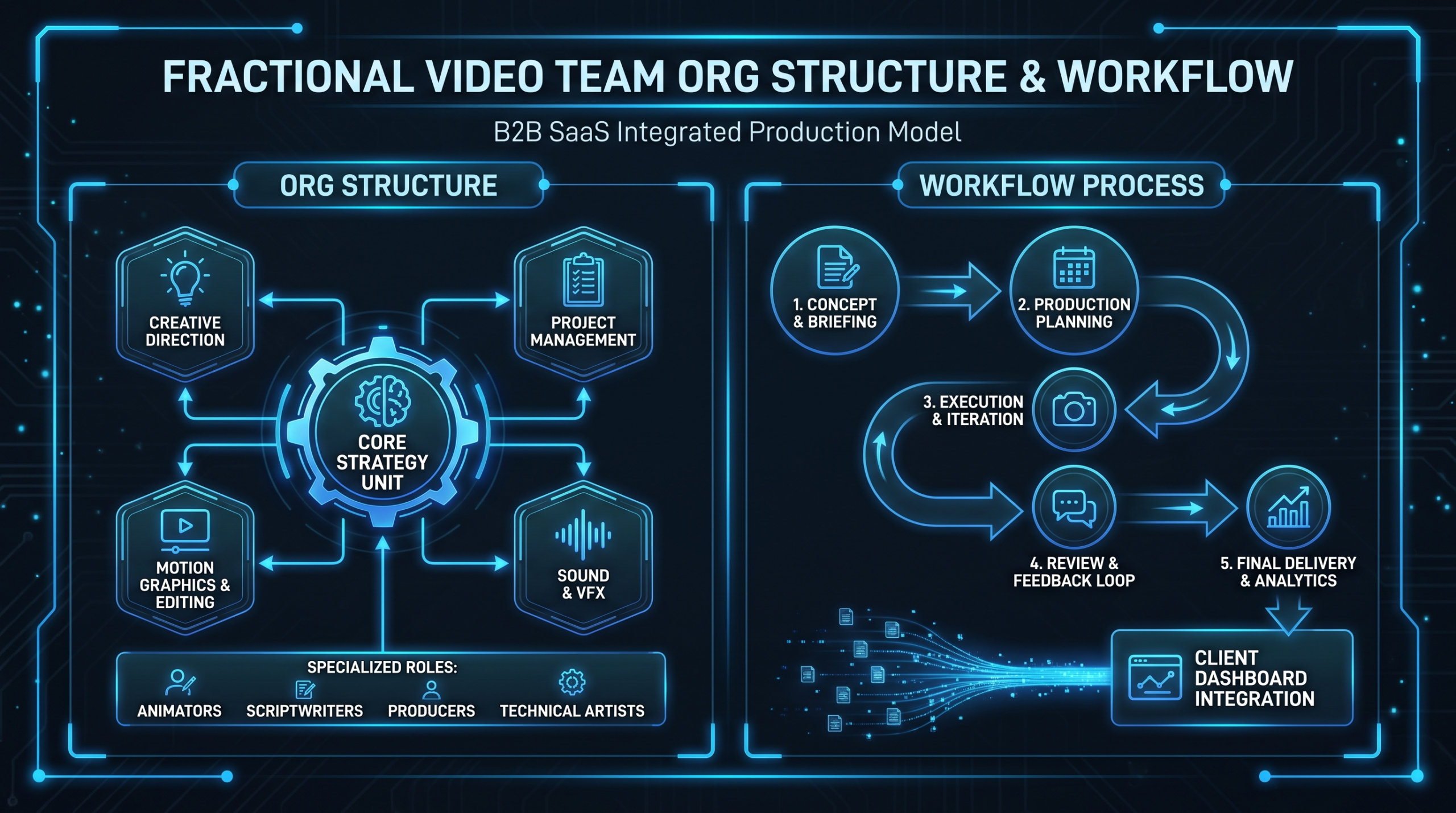
The composition varies by provider and plan, but a typical fractional arrangement for a Series B SaaS company might include:
- One to two dedicated editors — a senior editor who handles complex work (product demos, customer testimonials, executive thought leadership) and a junior editor for repurposing, social cuts, and supporting volume
- A dedicated project manager or account lead — your single point of contact, who handles briefing, feedback coordination, deadline tracking, and issue escalation
- Access to a creative director — for brand-level decisions, motion template creation, and quarterly creative reviews (usually shared across accounts rather than dedicated to one)
- Motion graphics support — either built into the plan or available on-call depending on tier
This structure mirrors a small in-house video team — without you bearing the cost of recruiting, onboarding, managing, or equipping any of them. When an editor leaves the provider, they replace them and maintain continuity on your account. That replacement risk, which is significant in the in-house model, becomes the vendor's problem entirely.
How It Compares to Every Other Model
The fractional model only makes sense in context. Here is how it stacks up against the four most common alternatives for a growth-stage SaaS company:
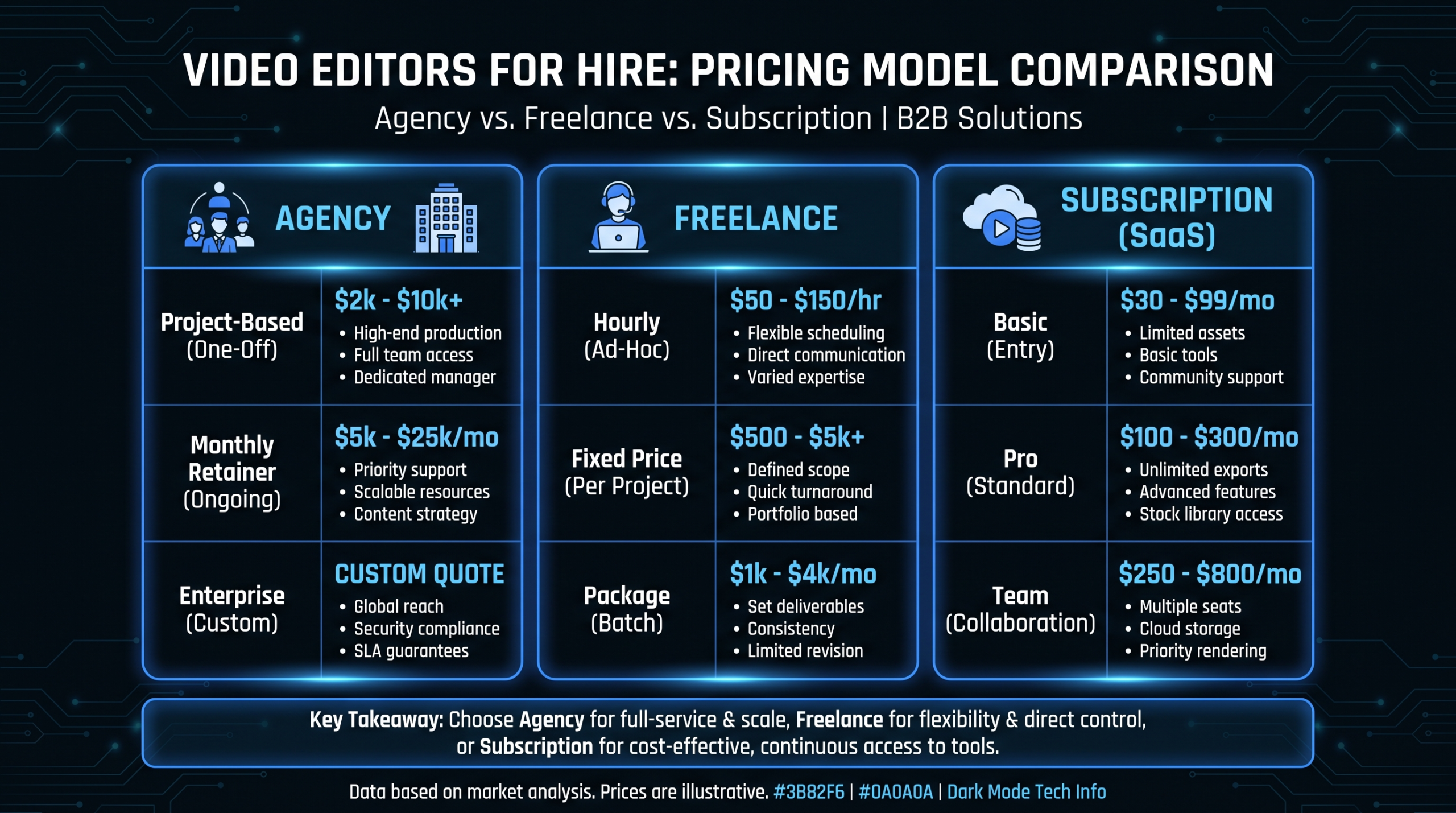
Fractional Video Team vs. Every Alternative
| Model | Brand Consistency | Typical Cost (Series B SaaS) | Scalability | Commitment |
|---|---|---|---|---|
| Fractional Team | High — same team, recurring | $5K–$16K/mo | Medium-High | 3–6 months minimum |
| Freelancers | Low — different person each time | $2K–$8K/mo (highly variable) | Low | None |
| Editing Subscription | Medium — shared editor pool | $2K–$6K/mo | Low (queue-limited) | Month-to-month |
| Traditional Agency | Medium — account team varies by project | $8K–$30K+/mo | High (full service) | Project-based or 6–12mo retainer |
| In-House Full-Time | Very High | $7K–$12K/mo all-in for 1 FTE | Very Low (headcount-limited) | Permanent hire |
Versus Freelancers
Freelancers offer flexibility that a fractional team does not — you can engage them for one project and walk away. The cost of that flexibility is reliability. Availability shifts without notice, quality varies by individual and by project, and every new engagement restarts the brand-learning curve. For companies serious about outsourcing video editing as a long-term strategy, the freelancer path works for occasional work but rarely for a content program designed to compound over time.
Versus Editing Subscriptions
"Unlimited" video editing subscriptions are tempting on paper. In practice, the throughput bottleneck — typically one active request at a time, 48–72 hour turnarounds — limits most basic plans to eight to twelve deliverables per month. More importantly, editing subscriptions draw from a shared pool of editors. You may get a different person on each request. For brand-sensitive work like product demos or executive thought leadership series, that inconsistency creates real problems that compound over time.
Versus Traditional Agencies
Traditional video production agencies are built for campaigns, not content programs. They excel at the flagship product video, the brand film, the high-production quarterly initiative — work with defined start and end points. The fractional model is built for the opposite: recurring, ongoing production where the team's accumulated knowledge is the primary asset. Agencies also carry significant overhead — large offices, large sales teams, creative directors allocated across dozens of accounts. Fractional providers run leaner, which does not always mean cheaper, but it does mean better alignment between what you pay and what you receive.
Versus Hiring In-House
A full-time mid-level video editor in a major US market costs $65–85K in base salary. Factor in 20–30% for benefits, $5–10K for equipment and software, and you are at $85–120K per year all-in — for one person with one skill set. When that person leaves, and video editors have historically high turnover in content roles, you restart from zero: recruiting, interviewing, onboarding, re-educating on your brand. A fractional team gives you multiple skill sets, built-in redundancy, and no recruiting exposure at a predictable monthly cost. The full case for SaaS video production as an external function is detailed, but the headline is this: most Series A–C companies are better served by investing in predictable external production capacity than in headcount that breaks whenever a key person leaves.
The Three Trust Objections — Answered
The fractional model makes intuitive sense on paper, but three objections consistently arise in conversations with VP Marketing and Head of Content buyers. They are legitimate concerns, not theoretical ones. Here is how serious teams address each one in practice.
Objection 1: "How do we maintain quality without full control?"
Quality control anxiety is almost always about process, not people. The solution is not to bring production in-house — it is to build an external team with the same structural safeguards you would use internally.
That means: a standardized brief template (not a Slack message that says "something like this video"), a written feedback protocol using timestamped comments rather than verbal calls where decisions evaporate, a defined revision round limit in the contract, and a monthly review cadence where output is assessed against documented standards.
The best fractional arrangements include a dedicated project manager whose explicit job is quality enforcement before anything reaches your desk. They own the internal review gate. If you are evaluating providers, ask: "What does your internal QA process look like before a video leaves your team?" A confident, specific answer indicates quality is structural. A vague answer about "our experienced editors" indicates it is accidental.
Clarity on what is included in a professional video editing service — deliverable formats, revision rounds, QA checkpoints, turnaround windows — should be spelled out completely in any fractional agreement before you sign.
Objection 2: "What about data security and NDA compliance?"
This concern surfaces most often at companies handling sensitive material: beta product demos for features not yet announced, M&A discussions captured on internal video, client testimonials subject to confidentiality requirements. It is a real concern, particularly at Series B–C where legal and compliance functions start having opinions about vendor relationships.
The framework that works is simple: treat the fractional team like any other Tier 1 vendor. This means a mutual NDA before any footage transfers, data handling provisions in the service agreement (where footage is stored, who has access, retention periods, deletion protocols on contract termination), and a defined offboarding procedure. Reputable fractional providers handle this as standard practice — they work with enough SaaS companies that their legal templates are already drafted and ready.
For cloud-based footage transfer, most professional providers use enterprise-grade solutions — Frame.io, Dropbox Business, Google Workspace with shared drives — with role-restricted access controls. Ask specifically: can editors access footage they are not actively assigned to? The answer should be no, and there should be a process to enforce it.
Objection 3: "Will they ever truly understand our brand?"
This is the most legitimate of the three objections, and the answer is nuanced: it depends on how you onboard them.
Brand consistency from an external team requires explicit documentation of things that feel implicit internally. Your motion graphics templates, your color palette, your font stack — those are easy to transfer. Harder to document: your preferred camera framing for executive interviews, the pacing you like in SaaS demo videos (typically tighter than most editors default to), what b-roll feels authentic versus generic for your product category, whether your brand voice on screen leans dry and authoritative or conversational and direct.
Teams that do this well create a "video brand guide" — not a 40-page document, but a 5–10 page reference covering the above, paired with annotated examples from your existing library: "this one is exactly right," "this one is too slow in the title sequence," "this testimonial cuts too many times, loses the emotional thread." The fractional team's job is to internalize this and build on it. With consistent editors over months, the accumulated context grows rapidly — and with it, the quality and efficiency of every subsequent project.
According to Wistia's research on video engagement patterns, viewer retention drops sharply when visual tone and pacing consistency break down across a content series. Brand continuity in production matters commercially, not just aesthetically — inconsistent video is not just an aesthetic failure, it is a performance failure.
When It Makes (and Doesn't Make) Sense
The Green Flags
A fractional video team is likely the right choice when:
- You are producing 8–20 videos per month — enough volume to justify dedicated capacity, not so much that you need a full internal production department
- Your content is recurring and predictable — product demos, customer stories, thought leadership series, onboarding videos, webinar repurposing — not one-off campaign work
- Brand consistency is a real business requirement — you are not just producing content, you are building a recognizable visual and tonal presence that compounds over quarters
- You have outgrown freelancers — you have tried the freelancer path and found yourself managing five different people across five different projects with five different quality levels and five different revision styles
- You cannot yet justify a full-time hire — either because the headcount budget is constrained, or because your video volume is not yet predictable enough to warrant a permanent role
The Red Flags — When NOT to Go Fractional
The fractional model is not the right choice when:
- Your video needs are highly variable or campaign-driven — if you produce 18 videos in Q4 and two in Q1, a fractional arrangement with minimum monthly commitments will not work economically
- You need full creative production including filming — most fractional arrangements cover post-production and editing; if you need on-location shoots, voiceover casting, or animation-from-scratch, you need a full-service agency or a hybrid arrangement
- Your immediate need is a high-stakes one-off — investor pitch videos, flagship brand films, and major campaign anchors are better served by a specialized agency that assembles a purpose-built team for that single project
- You are producing under four videos per month — at low volume, the economics of dedicated team capacity do not favor you; a freelancer or editing subscription is more cost-efficient until your volume grows
Fractional Video Team Providers Worth Knowing
The fractional video model does not yet dominate under a single industry term, which means providers with meaningfully different approaches compete under similar descriptions. Here is an honest look at the main options in 2026, evaluated against what Series A–C SaaS buyers actually care about:
Fractional & Dedicated Video Team Providers: 2026 Comparison
| # | Provider | Model | Best For | Pricing Range |
|---|---|---|---|---|
| 1 | Video Editing Company (VEC) | Dedicated fractional team: assigned editors + PM, SaaS-specialized, fixed transparent tiers, 90-day output guarantee | Series A–C SaaS companies needing consistent, recurring video production at scale | Growth $5K/mo · Core $9.5K/mo · Scale $16K/mo |
| 2 | Increditors | Dedicated editor pod: senior editor + junior editor + PM + creative director; full-service retainer model | YouTube creators, SaaS, finance, and education brands focused on channel growth and creative quality | Custom retainer, reportedly ~$2.5K–$12K+/mo; contact [email protected] |
| 3 | Vidico | Full-service SaaS video agency; project and retainer engagements including scripting and animation | Teams needing end-to-end production: scripting, animation, motion design, filming | Project-based; typically $8K–$25K+ per project |
| 4 | Superside | Design + video subscription; shared creative team model, not dedicated video editors | High-volume marketing teams needing both design and video under one platform subscription | Plans from approximately $5K–$20K+/mo; video is not the core focus |
| 5 | Vidpros | Async video editing subscription; queue-based model with shared editor pool, not dedicated | Individual creators and small teams needing fast turnaround on simple edits without brand complexity | Plans typically starting around $995–$1,995/mo |
VEC vs. Increditors — the honest comparison: Both offer the dedicated team model, but with different orientations. VEC is built specifically for B2B SaaS content programs and offers transparent fixed-tier pricing — you know exactly what you are paying before you engage, and the 90-day output guarantee ("double your video output or month four is free") reflects genuine confidence in the model for SaaS-specific content at volume. Increditors takes a broader mandate — YouTube creators through enterprise — with custom-quote pricing that reflects more bespoke engagement structures and a fully built-in creative direction layer from day one.
If your primary need is SaaS content at scale with predictable pricing and minimal negotiation friction, VEC is the natural first evaluation. If you want a fully custom-scoped editor pod with a creative director embedded from the start and you are comfortable working through a discovery process to get your pricing, Increditors is worth a direct conversation.
Pricing: What to Expect
Fractional video team pricing follows a consistent logic: you are paying for reserved capacity, not per-deliverable output. This is both the model's strength — predictable monthly costs — and its primary risk — you are paying whether or not your pipeline is fully utilizing the team that month.
Fractional Video Team Market Pricing — Tier Ranges
| Tier | Monthly Cost | Typical Team | Monthly Output | Best Fit |
|---|---|---|---|---|
| Entry | $3,000–$6,000 | 1 editor + shared PM | 6–10 videos/mo | Series A teams building early content programs |
| Growth | $6,000–$10,000 | 1 senior + 1 junior + dedicated PM | 12–20 videos/mo | Series B with an established content calendar |
| Scale | $10,000–$18,000 | 2 editors + PM + creative direction access | 20–35 videos/mo | Series B–C with high-volume, multi-format programs |
| Enterprise | $18,000–$30,000+ | Full pod: 3+ editors, animators, PM, creative director | 35–60+ videos/mo | Scale-stage companies running multiple content lines |
For context on how fractional pricing compares to per-minute and hourly billing alternatives, the detailed breakdowns of video production agency pricing models and video editing cost per minute are worth reading before you finalize a budget. The short version: at ten or more videos per month, fractional and dedicated-team arrangements are almost always more cost-effective than per-project or hourly billing — the per-unit cost advantage compounds as volume scales.
What You Should Negotiate
Unlike per-project pricing where scope is fixed in a statement of work, fractional arrangements have genuine room to negotiate on several dimensions:
- Term length versus monthly rate: A 12-month commitment should unlock 10–15% lower monthly pricing compared to a rolling 3-month arrangement. Ask for this explicitly — most providers will accommodate it.
- Rollover provisions: If you have a slower month, do unused hours or deliverables roll into the next billing period? Policies vary significantly across providers. Negotiate at least a 30-day rollover if it is not offered by default.
- Onboarding rate: The first four to six weeks involve slower output as the team calibrates to your brand. Ask whether there is a reduced rate during onboarding, or ensure the deliverable estimate explicitly accounts for the ramp-up period rather than promising steady-state numbers from week one.
- Exit terms: What is the minimum notice period to exit the arrangement? Thirty days is reasonable; ninety days is a risk if your business situation changes. Avoid unilateral lock-in provisions longer than 90 days unless you have strong confidence in your video program's continuity.
According to HubSpot's State of Video Marketing research, video is now the leading content format by ROI for B2B marketers. The conversation has shifted from "is video worth the investment" to "how do we structure our video production for long-term, compounding results." The fractional model is increasingly the structural answer for teams that have crossed that threshold.
How to Structure the First 90 Days
The fractional model's value is time-dependent — the team improves on your account with every project they complete. That improvement does not happen automatically. It requires deliberate structure in the first three months to accelerate the learning curve and establish production standards before volume ramps up.
Weeks 1–2: Brand Onboarding
Do not start with a production request. Start with a brand transfer session: a structured 60-minute call with your creative lead and the fractional team's PM and senior editor, followed by written documentation. Provide the following before production begins:
- Your brand kit — color palette, typography, logo usage, any existing motion templates
- Five to ten example videos annotated with specific comments: "the pacing in this cut is exactly right," "this title treatment is our standard," "the b-roll in this one is too generic — avoid stock footage that looks like everyone else's product demo"
- A list of feedback you have had to give repeatedly in past work — this is the highest-signal input you can provide
- Your standard brief template, or ask the team to provide theirs and align on a single shared format
Weeks 3–6: Calibration Phase
Start with lower-complexity, lower-stakes projects during calibration: a repurposed webinar clip, a short social cut, an internal enablement video. These are not throwaway work — they are calibration runs that allow the team to internalize your feedback patterns before you are committing them to a flagship product demo or an executive testimonial series. Expect to give detailed, written feedback during this phase. The investment in weeks three through six dramatically compresses revision cycles in weeks seven onward. Teams that skip this phase and go straight to complex deliverables almost universally report frustration in the first 60 days.
Weeks 7–12: Steady-State Production
By week seven, a well-structured fractional engagement should be operating at or near full output velocity. Your PM is anticipating needs before you brief them. The editor knows your preferences for pacing, on-screen text density, and b-roll selection without being told on every project. Revision cycles are converging toward one round rather than three. The VEC guarantee of doubling video output within 90 days — or month four is free — is calibrated to this timeline. By the end of the first quarter, you should have clear, measurable evidence of whether the model is working for your specific content program.
After month three, schedule a structured review: output volume versus target, average quality rating per deliverable type, revision round average, and cost-per-finished-video compared to your pre-fractional baseline. This data tells you whether to scale the engagement, maintain it at current levels, or course-correct before you renew.
Frequently Asked Questions
What exactly is a fractional video team, and how does it differ from a traditional agency?
A fractional video team is a dedicated, recurring group of editors and a project manager who work on your account over time — building brand knowledge that compounds with every project. A traditional video agency is structured for campaigns: new brief, new project team, fresh start each time. Fractional is for ongoing programs; agencies are for flagship projects. The practical difference shows up in revision cycles and brand consistency — a team that knows your brand cuts revision rounds by 50–70% compared to a team encountering your content for the first time.
How is a fractional video team different from a video editing subscription?
Editing subscriptions work from a shared pool of editors — you may receive a different person on each request. The "unlimited" label refers to the number of requests in the queue, not production throughput, which is constrained by sequential processing (typically one active request at a time with 48–72 hour turnarounds). A fractional team is structurally different: named editors assigned to your account, working in parallel if your plan supports it, with accumulated knowledge of your brand that grows over months. Subscriptions optimize for price and flexibility; fractional teams optimize for consistency and quality at volume.
What does a fractional video team typically cost for a Series B SaaS company?
For a Series B SaaS company producing 12–20 videos per month, a fractional team arrangement commonly runs $7,000–$12,000 per month. This typically covers a senior editor, a junior editor, a dedicated project manager, and access to motion graphics and creative direction support. Providers with transparent pricing include VEC, whose plans range from $5,000 to $16,000 per month across three fixed tiers, making budget planning straightforward. Custom arrangements from providers like Increditors may offer more flexibility in team composition but require a discovery call to get accurate pricing. At any budget level, the comparison should be against the all-in cost of a full-time hire plus the quality cost of the freelancer alternative.
Can a fractional team actually maintain brand consistency over time?
Yes — with deliberate onboarding. The critical structural difference between fractional and freelancer is personnel continuity: the same editor who learned your brand in month one is still your editor in month six. Brand consistency requires both upfront documentation (a video brand guide with annotated examples, not just a logo kit) and accumulated production experience. Teams that are well-onboarded commonly report that the fractional arrangement starts feeling indistinguishable from in-house by the end of the first quarter. Teams that skip the calibration phase and jump straight to complex deliverables tend to struggle for the entire first 90 days.
How do I know if my company is ready for a fractional video team?
Three signals indicate readiness: first, you are producing or planning to produce eight or more videos per month consistently; second, you have already experienced the quality and reliability problems of the freelancer model and those problems are affecting your content program; third, video has moved from a nice-to-have to a core channel in your marketing or sales strategy. If all three are true, the fractional model will almost certainly outperform your alternatives on a risk-adjusted basis. If you are not yet at eight videos per month, a simpler subscription model or a carefully curated freelancer relationship is likely the better fit until your volume grows into the fractional range.
Ready to Move Past the Freelancer Lottery?
Video Editing Company builds dedicated fractional teams for Series A–C SaaS companies. Growth at $5K/mo, Core at $9.5K/mo, Scale at $16K/mo — with a guarantee to double your video output in 90 days or month four is free.
Book a Free Strategy Call View Pricing Plans