Rush Fees, Raw Footage, Buyouts: Video Production Pricing Terms Decoded
TL;DR
- Rush fees typically add 25–100% to the base quote and kick in when turnaround is under 48–72 hours.
- Raw footage ownership defaults to the agency/production company unless your contract says otherwise — always negotiate this upfront.
- Usage rights buyouts range from a few hundred to tens of thousands of dollars depending on media type, territory, and exclusivity.
- Kill fees (cancellation fees) commonly run 25–50% of the total project cost if work has already begun.
- Revision rounds beyond contract scope cost $75–300/round for simple edits; more for complex changes.
- Music and talent licensing are often line items you pay separately — budgeting for them prevents nasty surprises.
Table of Contents
- The Master Glossary: 14 Terms You Must Know
- Rush Fees: What They Are and When They Apply
- Raw Footage Ownership: Who Gets the Files?
- Usage Rights, Licenses, and Buyouts
- Kill Fees and Cancellation Clauses
- Revision Rounds: What's Included and What Costs Extra
- Music, Stock, and Talent Licensing
- Market Rate Reference Table: All Fees at a Glance
- What to Ask Before Signing Any Video Contract
- FAQ
You get a proposal from a video production agency. The main number looks reasonable. Then the project wraps, the invoice arrives, and it's 40% higher than you expected.
Rush fees. Additional revision rounds. A licensing fee you didn't know was separate. Usage rights for a distribution channel you assumed were included. Raw footage you thought you owned — that you don't.
This isn't the agency being dishonest. It's the vocabulary problem. Video production contracts are written in industry shorthand that assumes familiarity with terms most buyers have never encountered. When both sides have different interpretations of the same word, budget overruns are practically guaranteed.
This guide decodes every major video production pricing term — what it means, what the real market ranges look like across freelancers, boutique agencies, and subscription services, and what you should negotiate before the project starts. We'll also look at how VEC's pricing structure handles these line items so you know exactly what's covered.
The Master Glossary: 14 Video Production Pricing Terms You Must Know
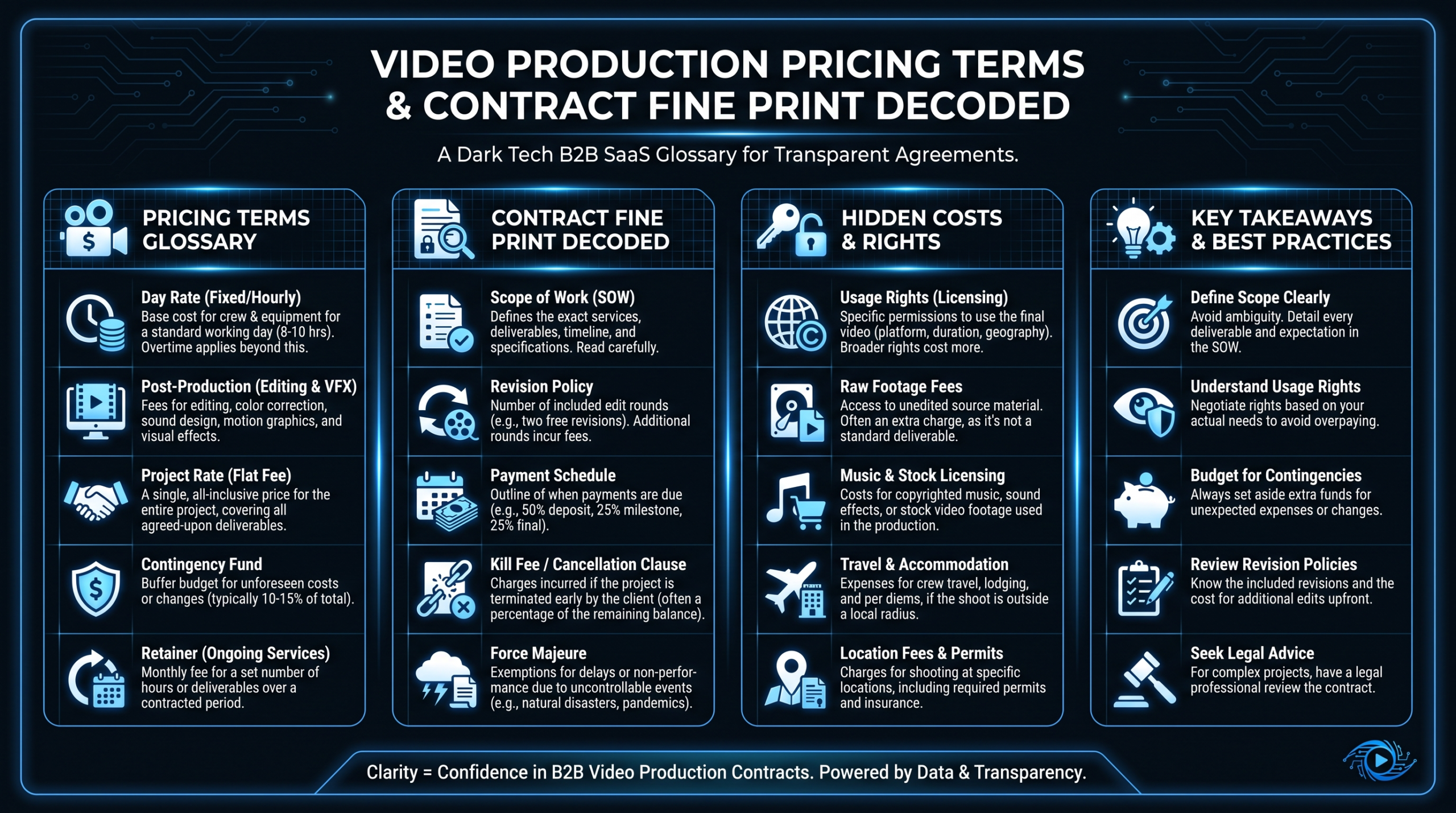
Before diving deep into each term, here's a high-level reference. These are the 14 most common contract and pricing terms that create confusion — and cost money when misunderstood.
Video Production Contract Terms — Quick Reference
| Term | Plain English | Typical Financial Impact |
|---|---|---|
| Rush Fee | Surcharge for urgent turnaround | +25–100% of base quote |
| Raw Footage | Unedited source files from production | $0–$2,000+ to obtain (often excluded by default) |
| Usage Rights / License | Permission to distribute the finished video in specific ways | $500–$50,000+ depending on scope |
| Buyout | One-time payment for unlimited usage rights | 3–10× the base production cost for broad rights |
| Kill Fee | What you pay if you cancel after work has started | 25–75% of total contract value |
| Revision Round | One pass of client-requested changes | $75–$500/round beyond contract scope |
| Revision Scope | What counts as a "change" vs. a new deliverable | Critical to define — vague scope causes disputes |
| Deliverable | Specific output the agency commits to produce | Each format/length counts as a separate deliverable |
| Music Licensing | Rights to use a song in your video | $50–$50,000+ depending on track and usage |
| Stock Footage License | Rights to use third-party video clips | $50–$500/clip (royalty-free libraries) |
| Talent Release | Legal permission from people appearing on camera | Required or you can't distribute; getting it retroactively is expensive |
| Exclusivity Clause | Agency agrees not to work with your competitors | Typically +10–30% premium on the monthly rate |
| Licensing Territory | Geographic scope where you can distribute the video | Global rights cost more than regional or national |
| Distribution Window | How long you can distribute the video before rights expire | Perpetual rights cost more than time-limited (1–3 year) licenses |
Now let's go deep on the six that cause the most budget surprises.
Rush Fees: What They Are and When They Apply
A rush fee is a surcharge the agency adds when you need a deliverable faster than their standard turnaround window. It compensates for the cost of reshuffling the production schedule, having editors work nights or weekends, and the operational disruption of prioritizing your job over other clients.
Standard Turnaround vs. Rush Turnaround
Most agencies publish a standard turnaround for each deliverable type. When you request something faster, the rush clock starts.
Standard vs. Rush Turnaround by Deliverable Type
| Deliverable | Standard Turnaround | Rush Threshold | Rush Fee Range |
|---|---|---|---|
| Social media clip (under 60 sec) | 3–5 business days | Under 48 hours | +25–50% |
| YouTube video edit (8–20 min) | 5–7 business days | Under 72 hours | +35–75% |
| Product demo video (2–5 min) | 7–10 business days | Under 5 business days | +40–75% |
| Animated explainer (60–90 sec) | 10–15 business days | Under 7 business days | +50–100% |
| Brand / hero video (1–3 min) | 2–4 weeks | Under 1 week | +50–100% |
How Rush Fees Are Calculated
Rush fee calculation varies by agency, but the three most common methods are:
- Percentage surcharge: The most common. A flat 25%, 50%, or 100% added to the base quote. A $3,000 product demo quote becomes $4,500 with a 50% rush fee.
- Daily rate: Some agencies charge by the "days saved." If standard turnaround is 10 days and you need it in 5, you pay for 5 days of expedited service.
- Flat fee by deliverable type: $250 rush for social clips, $750 for long-form edits, $1,500 for animated content — regardless of total project cost.
When Rush Fees Compound
The expensive scenario is back-to-back rush requests. If your approval process is slow (feedback arrives on day 5 of a 7-day project), the agency may charge a second rush fee to turn around revisions on the new compressed timeline. Build feedback buffer into your internal schedule to avoid this.
How to Minimize Rush Fees
- Build a content calendar and stick to it. Agencies that know a project is coming can schedule it ahead — no rush charge.
- Clarify your real deadline vs. your hoped-for date. Many clients request "as soon as possible" when they'd actually be fine with the standard window.
- Negotiate a "priority retainer" add-on. Some agencies offer a standing rush guarantee for a fixed monthly premium (typically $500–$1,500/month) that waives per-project rush fees.
- Consider a dedicated team arrangement. When you have a team assigned to your account, rush projects can be absorbed into the existing workflow without a surcharge. Providers like VEC structure their dedicated team model specifically so that urgent requests don't trigger extra fees.
Raw Footage Ownership: Who Gets the Files?
Raw footage is everything that was shot during production before editing — all takes, b-roll, interview clips, unused angles. It can represent tens or hundreds of gigabytes of video files with genuine strategic value: repurpose campaigns, future ads, social clips, internal training, historical documentation.
Here's the problem: most video production contracts give ownership of raw footage to the production company, not the client.
Why Agencies Keep Raw Footage by Default
This isn't malicious. The rationale is:
- Storage cost. Raw footage for a single day of shooting can exceed 500GB. Long-term storage is expensive and ongoing.
- Workflow complexity. Transferring, organizing, and labeling raw files adds hours of post-production admin time.
- Liability. Raw footage includes mistakes, out-of-context statements, and material that could be harmful if distributed improperly. Agencies prefer to retain control.
- Proprietary tools and workflows. Some production companies use proprietary color calibration or log formats that require their software to decode properly.
What "Raw Footage Delivery" Actually Costs
When agencies do offer raw footage delivery, it's typically priced as an add-on:
Raw Footage Delivery Pricing
| Project Type | Estimated Raw Footage Volume | Delivery Add-On Cost |
|---|---|---|
| Interview / talking head (half-day shoot) | 50–150GB | $200–$600 |
| Product demo (1-day shoot) | 100–300GB | $400–$1,000 |
| Brand video (multi-day shoot) | 300GB–2TB | $800–$2,500 |
| Event coverage (full day) | 200GB–1TB | $500–$1,500 |
What to Negotiate
- Explicit ownership clause: Your contract should state "all raw footage, project files, and source assets produced under this agreement are the exclusive property of [Client]."
- Retention window: If you don't want to pay for immediate delivery, negotiate a clause requiring the agency to retain files for 12–24 months with delivery available on request.
- Project files vs. raw footage: These are different things. Project files (.prproj, .aep, .fcpx) contain the editing timeline. Raw footage is the source media. You may want both.
For post-production retainer clients, this distinction matters a lot. See our guide on what's included in video editing services for a breakdown of what most retainers cover by default.
Usage Rights, Licenses, and Buyouts
This is the most legally complex and often the most expensive surprise in video contracts. Usage rights determine where, how long, and in what contexts you can distribute the finished video.
The Spectrum of Usage Rights
Usage rights exist on a spectrum from narrowly limited to fully unlimited:
Usage Rights Spectrum
| Rights Type | What It Covers | Typical Premium |
|---|---|---|
| Internal use only | Training videos, internal presentations — not for public distribution | No premium (often the base assumption) |
| Organic digital | Your website, YouTube channel, LinkedIn, email — unpaid distribution | Usually included in standard production fees |
| Paid digital (limited) | Paid social ads, Google/YouTube ads — specific platforms, limited duration | +$500–$3,000 per platform/year |
| Paid digital (broad) | All digital advertising channels, extended duration (2–3 years) | +$2,000–$10,000 |
| Broadcast rights | TV, streaming platforms, OTT | +$5,000–$50,000+ depending on reach |
| Full buyout / perpetual | All channels, all territories, no expiration | +$10,000–$100,000+ for major campaigns |
What a Buyout Actually Means
A "buyout" in video production doesn't mean you own the creative intellectual property. It means you've purchased unlimited usage rights for the finished video. The agency can still use it in their portfolio (unless you include a confidentiality clause), and they retain copyright over the production itself.
True creative IP assignment — where the agency transfers copyright — is rare and significantly more expensive. Most SaaS companies don't need it; what they need is a perpetual, all-channel usage license, which is functionally equivalent for their purposes.
Talent Rights: The Hidden Dimension
If human performers appear in your video — actors, spokespeople, even background extras — their usage rights are a separate layer. Standard talent releases grant usage rights for a specific period (typically one year) and for specific channels. If you want to run an ad featuring that talent for three years across all digital channels, you either need:
- A buyout negotiated with the talent upfront (more expensive day-of)
- Annual renewal fees to the talent agency or individual performer
This is why many B2B SaaS brands prefer video content that doesn't feature on-screen talent — customer testimonials with voiceover, product walkthroughs, screen recordings, and animation sidestep the talent rights complexity entirely. Our product demo video production guide covers the design choices that keep rights management simple.
Negotiating Usage Rights Before Production
The golden rule: negotiate rights before production starts, not after you've seen the finished video. Once you've seen a great final product and you're emotionally invested, your negotiating leverage drops to near zero. Agencies know this.
- Define your distribution plan in detail at the brief stage
- Ask the agency to include standard digital + paid social rights in the base quote
- Get broadcast/OTT rights quoted separately as an optional add-on
- Set a "rights option" that lets you expand rights within 6–12 months of delivery for a pre-agreed price
Kill Fees and Cancellation Clauses
A kill fee is what you owe the agency if you cancel the project after work has begun. It protects the agency from lost revenue when they've already committed time and resources to your project.
Standard Kill Fee Structures
Common Kill Fee Structures
| Cancellation Timing | Typical Kill Fee | What You're Paying For |
|---|---|---|
| Before any work begins | 0–15% (or deposit only) | Administrative time, opportunity cost |
| After brief / pre-production only | 25–35% of total | Pre-pro planning, scheduling, procurement |
| After production (shooting complete) | 50–60% of total | All production costs incurred |
| After first edit delivered | 65–75% of total | Production + initial post-production |
| After revisions requested | 75–90% of total | Substantially complete work |
When Kill Fees Are Legitimate vs. Predatory
A kill fee is legitimate when it reflects actual work performed and revenue the agency reasonably forfeited to take your project. It becomes predatory when:
- The kill fee is higher than the agency's actual costs + reasonable margin
- There's no graduated structure — some contracts charge 50% the moment you sign, regardless of work completed
- The definition of "cancellation" is vague enough that missing a milestone or slow feedback could trigger it
- The kill fee applies even when the agency fails to deliver on agreed timelines
Alternatives to Cancel to Protect Yourself
- Pause clauses: Negotiate the right to pause a project (typically for up to 60–90 days) without penalty if your circumstances change.
- Milestone-based billing: Tie payments to specific deliverables. You only pay for what's complete — the kill fee is inherently limited to completed milestones.
- Work product transfer on kill: If you pay a kill fee, the agency should deliver all work product completed to date — raw footage, rough cuts, design files. Don't pay a kill fee and walk away with nothing.
Monthly retainer structures (like those used by dedicated-team providers) largely eliminate the kill fee problem. Because billing is monthly and work is continuous, there's no large project payment at risk. A one-month notice period is the typical exit requirement — far cleaner than project-based kill fee clauses.
Revision Rounds: What's Included and What Costs Extra
Every video production contract specifies a number of "revision rounds" included in the base price. The definition of what constitutes a "round" is where contracts go wrong.
What a Revision Round Actually Means
A revision round is one cycle of: client provides feedback → agency implements changes → client reviews new version. The confusion is that agencies and clients interpret "feedback" differently.
Agency interpretation: All feedback received in one written document or call constitutes one revision round, regardless of how many individual changes are requested.
Client interpretation: One change = one revision. After 10 changes, clients often believe they've used 10 revisions when the agency considers it 1 round.
The right interpretation is the agency's — and it's more generous than clients realize. One round means you can submit a list of 25 changes and it still counts as one round. The problem comes when clients send feedback in installments: "change the color," then "now change the font," then "actually make the logo bigger" — each separate communication the agency may classify as a new round.
Standard Revision Round Inclusions by Tier
Revision Round Inclusions by Provider Type
| Provider Type | Rounds Included | Overage Cost | Notes |
|---|---|---|---|
| Freelancer (Upwork/Fiverr) | 1–2 rounds | $25–$100/round | Often negotiated at project start |
| Boutique agency (per-project) | 2–3 rounds | $75–$300/round | Scope of "round" usually defined in SOW |
| Full-service agency | 2–3 rounds | $150–$500/round | Major structural changes may be repriced |
| Video subscription services | "Unlimited" | $0 | Throughput limited, not revisions — but expect slow turnaround on heavy revision cycles |
| Dedicated team (retainer) | Typically unlimited | $0 | Team learns your preferences — fewer revisions needed over time |
What Counts as a "Major" Change vs. a Revision
This distinction matters because structural changes — rewriting the script, changing the narrative arc, adding an entirely new section — are typically priced separately, not as revision rounds.
- Revision (covered): Color correction adjustments, music track swap, text changes, logo size, timing tweaks, subtitle corrections, cut length adjustments
- Structural change (typically repriced): New script section, different visual approach, complete rearrangement of segments, adding animation to a live-action video
The clearest language I've seen in a contract: "A revision round covers refinements to the approved creative direction. A change to the approved creative direction is a new scope item, priced separately." Get something like that in your contract.
Pro tip: Batch your feedback. Review the full rough cut, compile all notes in one document, and submit them in a single communication. This is contractually one revision round and gives the editor a comprehensive picture that produces better results.
For more context on how per-minute complexity affects revision timelines, see our video editing cost per minute breakdown.
Music, Stock, and Talent Licensing
Licensing costs are almost always listed separately from production costs in quotes — or buried in the fine print. They can add thousands to your budget if you're not tracking them from the start.
Music Licensing
Music in commercial video content requires a synchronization license (sync license) — the right to pair a song with video footage. Costs vary enormously:
Music Licensing Cost Ranges
| Source | Cost | Use Case |
|---|---|---|
| Royalty-free library (Artlist, Epidemic Sound, Musicbed) | $200–$500/year subscription for unlimited tracks | Social media, YouTube, website videos, ads |
| Production music (custom license per track) | $50–$2,000/track depending on usage | Product demos, brand videos, mid-range ads |
| Sync license for a known song | $5,000–$500,000+ (independent to major label) | Brand campaigns, broadcast ads |
| Custom composed music | $500–$10,000+ | Brand anthems, product launches, premium content |
Most B2B SaaS content uses royalty-free library music. The agency either includes a subscription in their fee or passes the per-track cost to you. Always ask: "Is music licensing included, or is it a separate line item?"
Stock Footage Licensing
Stock clips — lifestyle footage, cityscapes, b-roll of people working — are licensed from libraries like Getty Images, Shutterstock, or Pond5. Standard royalty-free licenses cover most digital use cases, but broadcast licensing (TV, OTT) costs significantly more.
- Royalty-free stock clip: $50–$500/clip depending on resolution and source library
- Extended/broadcast license: $150–$2,000+/clip
- Custom footage (brand-specific b-roll shot by the agency): Typically included in the production budget, not licensed separately
Talent and Talent Release
Anyone on camera in a commercial video needs to sign a talent release before you can distribute the content. The release specifies:
- What they're permitting their likeness to be used for
- In what contexts (commercial, internal, educational)
- For how long (one year, three years, perpetual)
- In what territories (US, North America, worldwide)
When actors or professional spokespeople are involved, the release is paired with a talent fee. Standard day rates for commercial talent run $500–$5,000/day depending on experience and market (SAG vs. non-union). This is typically separate from the production agency fee — it's paid to the talent directly or through their agency.
Who Manages Licensing Compliance?
In a well-structured engagement, the production agency handles licensing procurement and passes costs to you with receipts. In looser arrangements, this is left to the client — creating risk if the agency uses unlicensed assets and you don't catch it.
For retainer clients, this is one area where dedicated-team models create clear accountability. Because the same team works on your content month after month, they maintain a consistent asset library and licensing records — you're not starting from scratch on every project.
Market Rate Reference Table: All Fees at a Glance
Here's a comprehensive reference table for the fees covered in this guide, showing how they scale across freelancer, boutique agency, and subscription/retainer models.
Video Production Pricing Terms — Market Rate Reference (2026)
| Fee Type | Freelancer | Boutique Agency | Subscription Service | Dedicated Team Retainer |
|---|---|---|---|---|
| Rush Fee | +25–75% (if they'll do it) | +35–100% | N/A (queue-based; can't rush) | Usually $0 (absorbed into workflow) |
| Raw Footage Delivery | Varies: sometimes free, sometimes $100–$300 | $400–$2,000 add-on | N/A (no filming) | Included or at cost (no markup) |
| Usage Rights (digital, paid) | Often not addressed — liability risk | +$500–$5,000 | Typically included for digital | Typically included for all digital channels |
| Usage Rights (broadcast) | Often not available | +$5,000–$50,000+ | N/A | Negotiated separately |
| Kill Fee | 25–50% of project | 25–75% of project | 30-day notice, no fee | 30–60 days notice, no fee |
| Additional Revision Round | $25–$100 | $75–$300 | $0 (unlimited revisions in queue) | $0 (included) |
| Music Licensing | Often ignored (liability risk) | $50–$500/track or library subscription passed at cost | Usually included (royalty-free) | Usually included (royalty-free library) |
| Stock Footage | $50–$200/clip (may use unlicensed — check) | $50–$500/clip, passed at cost | $0 (library access included) | $0 (library access included) |
| Additional Deliverable Format | $50–$150/format | $100–$400/format | $0 (submit as separate request) | $0 (included in workflow) |
The pattern is clear: per-project and freelancer engagements carry the most hidden fee exposure. Rush fees, additional revision rounds, and licensing costs are often loosely defined or excluded entirely. Dedicated team retainers — like VEC's Growth ($5K/mo), Core ($9.5K/mo), and Scale ($16K/mo) plans — consolidate most of these variables into a single predictable monthly investment. Rush fees are absorbed into the workflow. Music and stock licensing are included. Revision rounds are unlimited. The only meaningful line items you negotiate upfront are broadcast usage rights and talent fees for any human performances.
For a broader look at how these fee structures compare across different agency models, our video production agency pricing models guide walks through the full economics of each approach.
What to Ask Before Signing Any Video Production Contract
Print this checklist. Use it on every vendor conversation.
Ownership & Rights
- Who owns the raw footage after delivery?
- What usage rights are included in the base price?
- Which channels require additional licensing, and what's the cost?
- Are rights perpetual or time-limited?
- What territories do the rights cover?
- Do you retain the right to use this video in your portfolio/case studies?
Revision & Scope
- How many revision rounds are included?
- How do you define a "revision round" vs. a "new scope item"?
- What's the per-round cost for additional revisions?
- What counts as a "major structural change," and how is that priced?
Timing & Fees
- What's the standard turnaround for each deliverable type?
- At what point does a rush fee apply?
- How is the rush fee calculated?
- Is there a priority option I can pay monthly to avoid per-project rush fees?
Cancellation & Pausing
- What's the kill fee structure at each stage of production?
- Can I pause the project without a penalty?
- If I pay a kill fee, do I receive all completed work to date?
- What happens if you fail to deliver by the agreed timeline?
Licensing & Third-Party Costs
- Is music licensing included or billed separately?
- Is stock footage included or billed separately?
- Who is responsible for ensuring all assets are properly licensed?
- What happens if a licensing issue is discovered after delivery?
A vendor who can't or won't answer these questions clearly before you sign is telling you something important about how disputes will be handled after you sign.
For reference on what typical video editing service packages include, see what's included in professional video editing services.
Frequently Asked Questions
What is a rush fee in video production and how much should I expect to pay?
A rush fee is a surcharge for urgent delivery — typically applied when you need a video in less than 48–72 hours (for short-form content) or less than 5–7 business days (for longer productions). Market rates range from 25% for slightly accelerated timelines to 100% for extreme urgency. A $4,000 product demo with a 50% rush fee becomes $6,000. The best way to avoid rush fees is to plan your content calendar at least two to three weeks ahead and batch your requests with an agency that has reserved capacity for your account.
Do I automatically own the raw footage from my video production project?
No. By default in most production contracts, raw footage remains the property of the production company. Ownership transfers only if explicitly stated in the contract. If you want raw footage, negotiate it before signing — not after you've seen the finished product. Expect to pay an additional $200–$2,500 depending on project size and the agency's policy. If raw footage ownership matters to you strategically (it should for most companies), include an explicit "all raw footage is client property" clause in your contract.
What's the difference between a usage license and a buyout?
A usage license grants permission to distribute the video in specific contexts for a defined period (e.g., "paid social media in North America for one year"). A buyout is a one-time payment for a broad, often perpetual license that covers all or most distribution channels. A buyout doesn't transfer copyright — it just means you've paid for unlimited usage rights. For most B2B SaaS companies distributing content on their own channels and running digital ads, a broad digital license (not a full buyout) is sufficient and significantly less expensive.
How many revision rounds is reasonable to negotiate into a video contract?
Two to three revision rounds is industry standard for most project-based engagements. Remember that one round means you submit all your feedback in one batch — the agency implements everything, and that's one round consumed. Negotiate for two rounds included, with a clearly defined per-round overage rate of $75–$200. If you're working on a retainer or dedicated-team arrangement, revision rounds are typically unlimited — the team learns your preferences over time and the revision cycle shortens naturally.
What is a kill fee and can I negotiate a better structure?
A kill fee is what you pay if you cancel a project after work has begun. Standard structures range from 25% (pre-production only completed) to 75% (first edit delivered). Yes, you can negotiate better terms: push for a milestone-based structure where the kill fee equals the value of completed milestones, add a pause clause that lets you freeze the project for up to 60 days without penalty, and require that any kill fee payment comes with delivery of all completed work product to date. Retainer arrangements largely eliminate kill fee risk — you exit with 30 days' notice, not a percentage of a project quote.
Is music licensing typically included in video production quotes?
Not always, and the answer varies significantly by vendor type. Subscription-based and dedicated-team providers typically include royalty-free music library access in their fees. Freelancers and boutique agencies often quote music as a separate line item — or worse, use unlicensed tracks and leave the liability with you. Always ask explicitly: "Is music licensing included in this quote, or is it billed separately?" If it's separate, expect $50–$500 per track for royalty-free library music, or significantly more for commercial sync licenses on recognized songs.
Ready for a Contract That Has No Hidden Fees?
VEC's dedicated team plans include unlimited revisions, rush-free workflow, royalty-free music, and clear usage rights for all digital channels — one flat monthly fee, no surprises. Book a free strategy call to see which plan fits your content volume.
Book a Free Strategy Call View Pricing Plans