Corporate Video Cost: Startup to Enterprise
TL;DR — What You'll Learn
- Freelancers typically charge $500–$5,000 per corporate video depending on complexity and location.
- Full-service agencies run $5,000–$50,000+ per project; enterprise productions can exceed $100K.
- Subscription and dedicated team models deliver the lowest per-video cost at scale — plans typically start around $5,000/month.
- The biggest hidden costs are revisions, rush fees, and footage organization — not the editing itself.
- Series A–C SaaS teams commonly report their best unit economics from dedicated video teams at 10+ videos/month.
Table of Contents
- What Counts as a Corporate Video (and Why It Matters for Budgeting)
- The 6 Factors That Drive Corporate Video Production Cost
- Corporate Video Pricing by Production Tier
- Typical Budgets by Company Stage
- Top Corporate Video Production Options Compared
- Hidden Costs Most Budgets Miss
- Build In-House vs. Outsource: The Real Cost Math
- How to Stretch Your Video Budget Further
- FAQ
Corporate video production cost is one of those topics where the published numbers vary by 10x depending on who you ask — and both ends of the range can be correct. A Series B SaaS company and a bootstrapped startup have genuinely different needs, markets, and production standards. So does the freelancer on Upwork and the full-service production house in Manhattan.
This guide gives you the actual numbers across every tier: what freelancers charge, what agencies charge, what enterprise-grade production costs, and — critically — how to figure out which tier actually makes sense for your stage. We'll cover the cost drivers, the hidden fees, the build-vs-buy math, and the fastest way to get your per-video cost down as you scale.
No padding, no "it depends" non-answers. Real ranges, real structures, real tradeoffs.
What Counts as a Corporate Video (and Why It Matters for Budgeting)
"Corporate video" is a catch-all that covers radically different production requirements. A 60-second product demo animation and a 20-minute executive keynote video share a category but nothing else in terms of cost. Before you build a budget, know what type you actually need:
Corporate Video Types and Typical Cost Ranges
| Video Type | Typical Duration | Post-Only Range | Full Production Range |
|---|---|---|---|
| Product demo / walkthrough | 2–5 min | $800–$3,500 | $3,000–$15,000 |
| Explainer (animated) | 60–90 sec | $2,500–$8,000 | $5,000–$25,000 |
| Customer testimonial / case study | 2–4 min | $1,000–$4,000 | $4,000–$18,000 |
| Brand / culture video | 1–3 min | $2,000–$8,000 | $8,000–$50,000+ |
| Executive thought leadership | 5–20 min | $1,500–$5,000 | $5,000–$20,000 |
| Sales enablement / VSL | 3–10 min | $1,500–$6,000 | $5,000–$20,000 |
| Onboarding / training series | 5–30 min each | $2,000–$8,000/video | $8,000–$40,000/video |
| Social / repurposed clips | 15–60 sec | $200–$800 | $500–$2,500 |
Post-only means you're providing raw footage and paying for editing, motion graphics, sound design, and delivery. Full production includes pre-production (scripting, storyboarding, casting) and filming. Understanding which you need determines which budget tier applies to you.
For a deeper breakdown of post-production costs specifically, see our guide on video editing cost per minute.
The 6 Factors That Drive Corporate Video Production Cost
Two companies can quote you $3,000 and $30,000 for what sounds like the same video. Here's why — and which factors you can actually control.
1. Pre-Production Scope
Scripting, concept development, storyboarding, casting, location scouting — none of this is cheap, and it's easy to underestimate. A scripted 2-minute brand video might require 20+ hours of pre-production work before a camera turns on. If you provide a finalized script and clear creative brief, you can cut this cost by 30–50% by doing pre-production in-house.
2. Shoot vs. Post-Only
This is the single biggest cost lever. Adding a shoot day to a project can add $5,000–$25,000 depending on crew size, location, and equipment. Many corporate videos — demos, explainers, thought leadership content — can be produced entirely in post using screen recordings, existing footage, stock, and voiceover. If you're managing a tight budget, outsourcing video editing post-production on footage you already have is often the highest-ROI move.
3. Video Length and Complexity
A 90-second animated explainer isn't three times cheaper than a 4-minute version — complexity grows non-linearly. Motion graphics, 3D elements, custom illustrations, and complex color grades all add time regardless of final runtime. Agencies commonly report that a 90-second animated video takes 60–80% as long to produce as a 4-minute talking-head edit with basic graphics.
4. Motion Graphics and Animation
Custom motion graphics are where budgets quietly balloon. Animated text, lower thirds, data visualizations, and branded transitions take 2–5x longer to produce than straight cuts. If your brand guidelines require specific animated elements on every video, factor that into every line item. A standard cut might cost $1,500; the same video with custom motion graphics might cost $4,000–$6,000.
5. Revision Rounds
Revision structure can add 20–40% to a project budget if you're not careful. Most quotes include 2 structured rounds of revisions. A video that goes through 4–5 rounds of stakeholder review — common at enterprise companies with approval hierarchies — can double the editing cost. Establishing an internal approval process before kickoff is one of the best cost-control measures you can implement.
6. Turnaround Time
Rush fees are real. Standard turnaround for a polished corporate video ranges from 10–21 business days. Need it in 5? Most agencies charge a 25–50% rush premium. Need it in 48 hours? Expect to pay 75–100% more than the standard rate, if the agency can accommodate at all.
Corporate Video Pricing by Production Tier
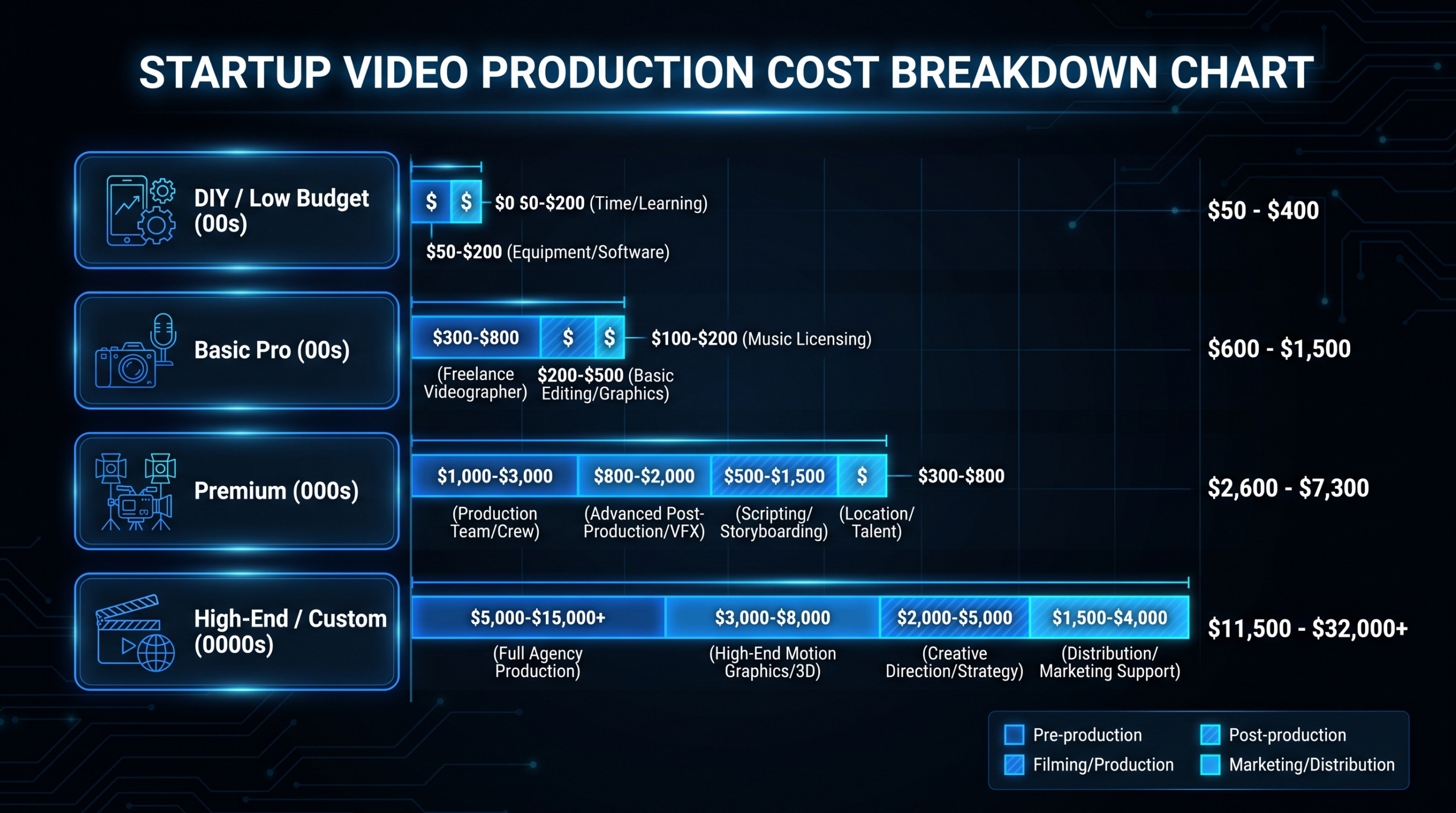
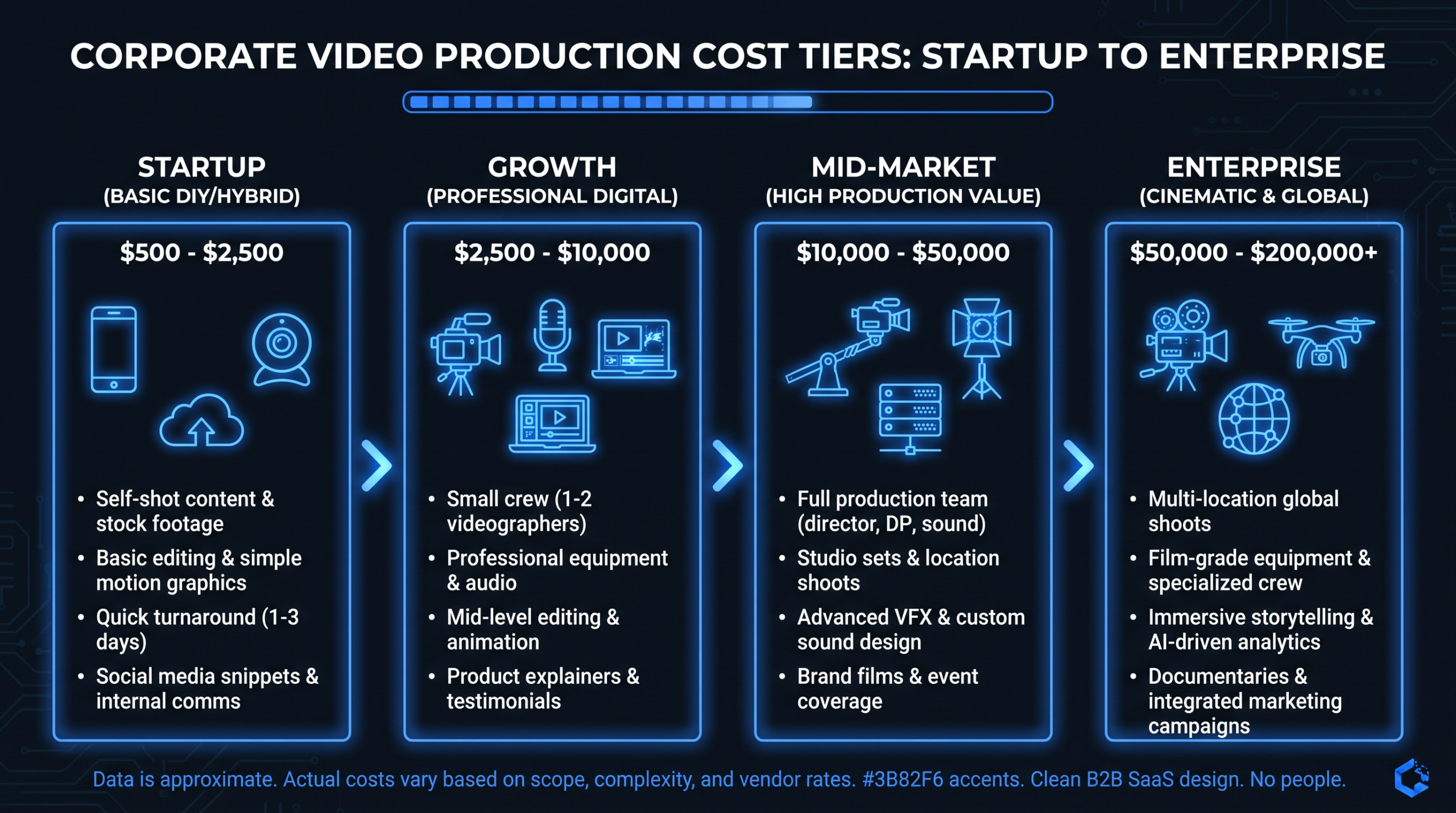
There are four distinct production tiers for corporate video. Each has a different cost structure, quality ceiling, and use case.
Tier 1: Freelancers ($500–$5,000 per video)
Freelancers on platforms like Upwork, Fiverr Pro, and direct referrals cover the widest quality range. A junior editor in a lower-cost market might charge $15–$25/hour; a senior freelance editor in the US or UK typically charges $75–$150/hour. For a detailed look at rates by location, our video editing hourly rate by country guide breaks this down.
Freelancers make sense for: one-off projects, simple edits, tight budgets. They're a poor fit for ongoing volume, brand consistency, or complex animated work — most specialize in one area and may not cover the full stack (editing + motion graphics + sound design + color).
Tier 2: Boutique / Mid-Market Agencies ($3,000–$20,000 per video)
Regional agencies and specialist video houses typically charge per-project rates in this range. You get a team (producer, editor, sometimes a director), structured processes, and more predictable quality. The tradeoff: higher cost per video, longer timelines, and contracts that don't always accommodate your content cadence if you're producing more than 4 videos/month.
Tier 3: Subscription and Dedicated Team Models ($5,000–$20,000/month)
This is where the economics shift. Monthly subscription models and dedicated team arrangements bundle editing capacity into a recurring fee. For companies producing 8–20+ videos/month, the effective per-video cost drops dramatically compared to per-project agency work.
For example, a dedicated team plan at $9,500/month delivering 15 videos produces an effective per-video cost of ~$633 — a fraction of what a per-project agency charges for comparable quality. See our agency pricing models comparison for a deeper breakdown.
Tier 4: Enterprise / Full-Service Production ($25,000–$200,000+ per project)
Enterprise-grade productions — Super Bowl commercials, major brand films, global campaign launches — involve production companies with large crews, extended shoot schedules, and post-production teams in dedicated suites. This tier is rarely relevant for SaaS marketing teams. If you're here, you're likely hiring a production company directly or working with a major agency holding company.
Corporate Video Cost by Production Tier
| Tier | Who It's For | Typical Cost | Best Use Case |
|---|---|---|---|
| Freelancer | Bootstrapped / seed-stage | $500–$5,000/video | One-off edits, simple social content |
| Boutique agency | Seed–Series A | $3,000–$20,000/video | Brand videos, 1–3 videos/month |
| Subscription / dedicated team | Series A–C | $5,000–$20,000/month | Ongoing content programs, 8–30 videos/month |
| Enterprise production | Public companies, brands | $25,000–$200,000+/project | Campaign launches, broadcast content |
Typical Budgets by Company Stage
Benchmarking against your stage is often more useful than looking at industry averages. Here's what companies at each stage typically spend on corporate video:
Bootstrapped / Pre-Seed ($500–$3,000/month)
At this stage, video budgets are tight and allocation is selective. Most teams focus on one or two high-impact video types: a product demo, a homepage explainer, or founder thought leadership. Freelancers and simple editing subscriptions are the primary options. Expect to do significant internal work (scripting, creative direction) to keep costs contained.
Seed Stage ($2,000–$8,000/month)
Seed-stage companies start building a content program but are still selective about production investment. A common pattern: one polished brand or product video per quarter (agency-produced), plus ongoing social clips and educational content handled by a freelancer or light subscription. Total monthly video spend in this range often produces 4–8 pieces of content.
Series A ($5,000–$15,000/month)
Series A is where video typically becomes a real line item in the marketing budget. Companies at this stage often hire their first video content manager or contract a boutique agency on retainer. Demand for SaaS-specific content — product walkthroughs, customer testimonials, sales enablement videos — accelerates. This is also where dedicated team models start to make economic sense, especially for teams producing 8+ videos/month. Our SaaS video production guide covers the specific formats that drive pipeline at this stage.
Series B–C ($10,000–$40,000/month)
At Series B–C, video production is typically a core function of content marketing, demand gen, and customer success. Teams commonly report maintaining dedicated editing partners at this stage — either in-house editors, a dedicated agency team, or a hybrid. The volume of content (YouTube, social, sales enablement, onboarding, event recap) requires a scalable production infrastructure, not one-off project work.
Enterprise ($30,000–$150,000+/month)
Enterprise video budgets span a wide range because they often include multiple teams (marketing, product, HR, executive comms) with separate video needs. Large enterprises frequently maintain relationships with multiple production partners simultaneously — a full-service production company for flagship content and a dedicated editing team for ongoing high-volume output. According to Wistia's video benchmarks research, companies with the strongest video performance tend to publish consistently at high volume rather than investing everything in a small number of polished pieces.
Top Corporate Video Production Options Compared
The market for corporate video production has fragmented significantly. Here's an honest comparison of the main options, including how they stack up on cost, quality, and fit for B2B SaaS teams:
Corporate Video Production Providers: Side-by-Side
| # | Provider | Model | Starting Price | Best For | Cons |
|---|---|---|---|---|---|
| 1 | Video Editing Company (VEC) | Dedicated team, monthly plans | $5,000/mo (Growth) | Series A–C SaaS, 8–30 videos/month, guaranteed 2x output in 90 days | Not ideal for one-off projects; requires ongoing volume |
| 2 | Increditors | Custom retainer, dedicated editor pods | ~$2,500–$12,000+/mo | YouTube creators, SaaS, finance, education; known for doubling channel performance; senior editor + junior editor + PM + CD model | Custom-quote pricing (no instant tiers); not exclusively SaaS-focused |
| 3 | Tasty Edits | Subscription | ~$2,495/mo | YouTube creators, social content | Sequential queue; throughput-limited; less suited for complex B2B content |
| 4 | Vidpros | Subscription | ~$995/mo | Simple edits, social clips, podcasters | Quality ceiling lower than dedicated team options; limited motion graphics |
| 5 | Local / Regional Agency | Per-project | $3,000–$20,000/video | Brand films, one-off campaign videos, shoot-inclusive projects | High per-unit cost; inconsistent team; no volume efficiency |
| 6 | Senior Freelancer (Upwork/direct) | Hourly / per-project | $50–$150/hr | Supplementing in-house, simple edits, tight budgets | No capacity guarantee; inconsistent; managing multiple freelancers adds overhead |
VEC's three-tier plan structure — Growth ($5K/mo), Core ($9.5K/mo), Scale ($16K/mo) — is designed specifically for B2B SaaS content programs. Each plan includes a dedicated team (not a rotating pool) and comes with a guarantee: double your video output in 90 days or month four is free. You can review the full plan breakdown on the VEC pricing page.
Increditors takes a similar dedicated-team approach with a custom retainer structure. Their editor pods (senior editor + junior editor + PM + creative director) work well for brands that want deep creative involvement. They're particularly strong for YouTube channel growth — teams commonly report significant retention and subscriber improvements after 60–90 days. The tradeoff is that pricing isn't self-serve; you need a discovery call to get a quote.
Hidden Costs Most Budgets Miss
The quote you get is rarely the number you pay. Here are the costs that routinely catch marketing teams off guard:
Revision Overruns
Most agency quotes include 2–3 rounds of revisions. "One round" means one set of consolidated feedback — not multiple back-and-forth emails. When stakeholder approval requires 4+ rounds (common in enterprise environments with legal, brand, and executive sign-off), revision costs can add $500–$3,000 per video on top of the quoted price.
Stock Footage and Music Licensing
Stock footage (Shutterstock, Getty, Artgrid) and licensed music (Musicbed, Artlist) are rarely included in production quotes. A video that needs 10 stock clips and a licensed track might add $500–$2,000 to the budget. Perpetual licensing for broadcast or paid advertising typically costs significantly more than standard web-use licenses.
Format Multiplications
Your 16:9 YouTube video becomes a 9:16 TikTok, a 1:1 LinkedIn post, and a 4:5 Instagram reel. Each format adaptation requires re-editing — not just cropping. If this isn't in your original brief, agencies charge separately, typically $150–$500 per format variant.
Rush Fees
Standard turnaround is 10–21 business days for polished work. Compressing that to 5 days typically adds a 25–50% premium. Two-day delivery, if available, can cost double the standard rate. Build realistic timelines into your content calendar and you'll eliminate this cost entirely.
Footage Organization
Agencies commonly report spending 15–25% of post-production time just organizing raw footage — syncing audio, sorting takes, finding selects across 200GB of files. If your footage arrives labeled, organized, and logged, you can negotiate a lower rate or get more editing hours for the same budget.
Onboarding Overhead
Every new agency relationship has a ramp-up period — typically 2–4 weeks while the team learns your brand voice, visual style, and feedback preferences. During this period, output quality is lower and revision rounds are higher. Factor this into your first-month expectations and budget for more back-and-forth than your steady state.
Build In-House vs. Outsource: The Real Cost Math
For Series A–C companies debating whether to hire full-time editors vs. outsource, the math usually favors outsourcing — but the gap is more nuanced than vendors typically present.
In-House Editor vs. Dedicated Agency Team: Annual Cost Comparison
| Cost Item | 1 In-House Senior Editor (US) | Dedicated Agency Team (VEC Growth Plan) |
|---|---|---|
| Base salary / plan cost | $75,000–$95,000/yr | $60,000/yr ($5K/mo) |
| Benefits (health, 401k, etc.) | $18,000–$25,000/yr | $0 |
| Software licenses (Premiere, After Effects, DaVinci, etc.) | $3,000–$6,000/yr | $0 (included) |
| Hardware (workstation, storage) | $4,000–$8,000/yr (amortized) | $0 |
| Recruitment / onboarding | $5,000–$15,000 one-time | $0 |
| Sick leave / vacation coverage | Production stops | Team continuity maintained |
| Total Annual Cost | $105,000–$149,000+ | $60,000 |
| Capacity | 10–15 videos/month (one person) | 10–20 videos/month (team) |
The cost advantage of outsourcing is clearest at the Growth tier. As you scale to the Core ($9.5K/mo) or Scale ($16K/mo) plans, you're replacing what would be a 2–3 person in-house team — a difference of $200,000–$350,000+/year in fully-loaded headcount costs.
In-house makes sense when: you need an editor available for real-time collaboration (same-office working sessions), your content is highly proprietary or confidential, or you've scaled to a volume where a full in-house studio is more cost-effective than an external team. For most Series A–B companies, that crossover point isn't reached until you're producing 40+ videos/month.
"We went from 6 videos/month to 18 within the first quarter by switching to a dedicated team model. The creative director alone saved us more time than the entire retainer cost." — Head of Content, B2B SaaS company
How to Stretch Your Video Budget Further
Regardless of which production tier you're in, these practices consistently improve your cost-per-result ratio:
1. Maximize Repurposing
One 15-minute thought leadership video can become: a YouTube upload, 6 social clips, 3 audiograms, a highlights reel, and 2 blog post embeds. Plan for repurposing before production, not after. Agencies that understand this workflow can build it into the production process rather than billing it as separate work. See what video editing services typically include to know what to ask for upfront.
2. Standardize Your Briefs
The single biggest driver of revision rounds is a vague brief. Agencies that receive organized footage, a written script or shot list, reference videos, and a clear feedback process consistently deliver on budget. Teams that send incomplete briefs consistently go over. This costs nothing to fix and typically reduces revision rounds by 40–60%.
3. Batch Your Production
Filming 8 videos in two days costs significantly less than filming 8 videos across 8 separate sessions. Batch shooting amortizes location costs, crew costs, and setup time. For executive thought leadership and educational content especially, batching 4–6 pieces per session is standard practice among teams with mature content programs.
4. Commit to Longer Terms
A 12-month commitment to a dedicated team or retainer typically costs 10–20% less per month than a rolling month-to-month arrangement. Agencies value revenue predictability and will discount for it. If you have confidence in your content program's longevity, the discount pays for itself.
5. Separate Production Tiers by Content Type
Not all corporate videos need the same production level. A polished brand film warrants premium production; a weekly educational LinkedIn video doesn't. Segment your content calendar by tier and allocate budget accordingly. Teams that apply enterprise production standards to all content consistently overspend. According to HubSpot's State of Video Marketing research, high-performing video teams publish more frequently at varying quality levels rather than publishing less at uniform high quality.
6. Track Cost Per Result, Not Cost Per Video
The right metric isn't cost per video — it's cost per qualified lead, cost per demo booked, cost per customer converted. A $15,000 product demo that drives 50 qualified demos is cheaper than a $3,000 explainer that drives none. Tracking outcome-based metrics forces cleaner budget decisions and gives you the data to justify increased video investment to leadership.
Frequently Asked Questions
What is a realistic budget for a corporate video at a Series A SaaS company?
Series A SaaS companies commonly report video budgets of $5,000–$15,000/month, covering 4–12 pieces of content (demos, social clips, educational videos). If you're producing fewer than 6 videos/month, a boutique agency retainer or freelancer arrangement often works. At 8+/month, dedicated team models from providers like VEC typically offer better per-video economics and more consistent output.
How much does a 2-minute corporate video cost?
It depends heavily on what "2-minute corporate video" means. A 2-minute product demo edited from screen recordings: $800–$3,000. A 2-minute animated explainer with custom motion graphics: $5,000–$15,000. A 2-minute brand film with a shoot day, actors, and full post-production: $15,000–$50,000+. Define the type before comparing quotes — they're measuring entirely different things.
What's the difference between post-only pricing and full production pricing?
Post-only means you provide raw footage (screen recordings, filmed content, existing assets) and pay only for editing, motion graphics, sound design, color grading, and delivery. Full production includes pre-production (scripting, storyboarding, casting) and filming on top of post. Post-only costs are typically 30–70% lower than full production for the same final video length. Most SaaS companies producing content at volume work on a post-only model, filming in-house or with a videographer and outsourcing all post-production work.
Is it cheaper to hire an in-house video editor or use an agency?
At low volumes (under 8 videos/month), the costs are roughly comparable, but in-house editors offer more flexibility for real-time collaboration. At higher volumes (10+ videos/month), dedicated agency teams typically cost 40–60% less than equivalent in-house headcount when you factor in salary, benefits, equipment, software, and recruitment. The fully-loaded annual cost of one senior in-house editor in the US commonly runs $105,000–$150,000; a dedicated team plan covering similar or greater capacity typically runs $60,000–$115,000/year.
How do I know when to upgrade from a freelancer to a dedicated video team?
Three signals indicate it's time to move up: (1) you're producing 6+ videos/month and spending more time managing freelancers than on strategy; (2) inconsistent quality or missed deadlines are creating internal friction; (3) your content program has a consistent format and cadence that benefits from a team that deeply knows your brand. At that point, the operational overhead of freelancer management typically exceeds the cost premium of a structured team arrangement.
Ready to Scale Your Corporate Video Output?
VEC's dedicated teams work exclusively with B2B SaaS companies producing consistent video at volume. Growth, Core, and Scale plans from $5K/month — and a guarantee to double your video output in 90 days or month four is on us.
Book a Free Strategy Call View Pricing