In-House Editor Salary vs Agency: Full Cost Math
TL;DR — Key Numbers
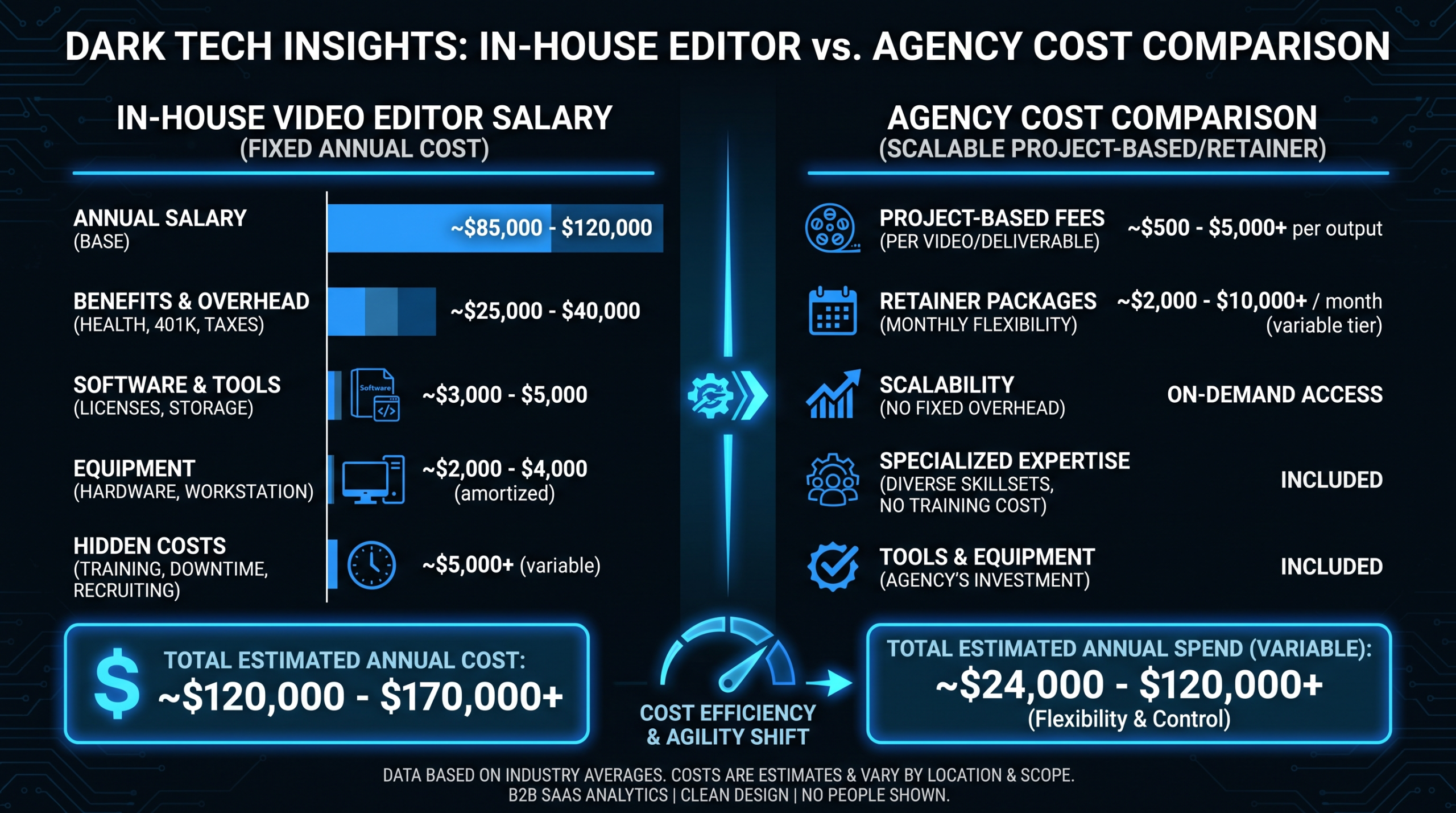
- Mid-level in-house editor: $120,000–$160,000/yr fully loaded (salary + benefits + tools + overhead)
- Senior in-house editor: $165,000–$215,000/yr all-in
- First-year costs including hiring and ramp: add $20,000–$40,000 on top of the fully-loaded annual figure
- VEC Growth retainer ($5,000/mo = $60,000/yr): typically delivers comparable or greater output at 40–60% lower total cost than one in-house hire
- Breakeven point: in-house only wins economically when you need the sustained equivalent of 3+ dedicated editors
Table of Contents
The conversation usually starts with a CFO question: "Why are we paying an agency when we could just hire someone?" It's a fair challenge. A quick salary search shows video editors earning $65,000–$90,000 a year. That looks like a deal next to a $9,500/month agency retainer. But that comparison skips every cost that makes hiring more expensive than it first appears — and ignores what a well-structured agency actually delivers.
This guide runs the full math. Every line item, every hidden cost, every stage-specific scenario. The goal is to give you the real numbers so you can make the right call for your team — not the one that looks best in a single spreadsheet cell.
What an In-House Video Editor Actually Costs in Base Salary
Let's start with base salary, then layer everything on top. Compensation for video editors varies significantly by market, experience, and company stage. For B2B SaaS companies competing for talent in professional markets, the ranges below reflect what teams commonly report paying in 2026:
Video Editor Base Salary Ranges — B2B SaaS / Tech Context
| Level | Experience | Base Salary Range | Market |
|---|---|---|---|
| Junior Editor | 0–2 years | $45,000–$65,000 | US national |
| Mid-Level Editor | 3–5 years | $70,000–$95,000 | US national |
| Senior Editor | 6–10 years | $95,000–$135,000 | US national |
| Lead / Creative Director | 10+ years | $130,000–$180,000 | US national |
| Mid-Level Editor | 3–5 years | $85,000–$115,000 | NYC / SF / LA |
| Senior Editor | 6+ years | $115,000–$160,000 | NYC / SF / LA |
According to the Bureau of Labor Statistics Occupational Outlook for Film and Video Editors, median annual wages nationally sit below $70,000 — but those figures include roles across broadcast, film, and local production. B2B SaaS companies competing for editors who understand product marketing, can interpret briefs independently, and produce polished work without hand-holding typically report paying 25–40% above national median. Plan to anchor at the mid-level range minimum if quality and autonomous execution matter to your content program.
The Role Is Almost Never Just One Person
Before running the math on a single hire, acknowledge a structural reality: one video editor at 160 hours per month cannot sustain a real content program at growth-stage volume. They get sick, take vacation, hit creative blocks, and eventually leave. Most marketing teams that "hire one editor" either burn that person out within 18 months or find themselves capacity-constrained within 6 months of building real video momentum.
If your content plan calls for more than 8–10 videos per month at moderate complexity, one editor is not a solution — it's a bottleneck. You're doing the cost comparison for a team, not a hire. Keep that in mind as you read the numbers below.
The Fully-Loaded Cost: Every Line Item
Base salary is the number on the offer letter. The fully-loaded cost is what the hire actually costs the company. Here's every component you need to account for:
The Benefits Multiplier
In the United States, employer-paid benefits commonly add 25–40% on top of base salary. The components that make up this multiplier for a typical Series A–C SaaS company:
- Health, dental, and vision insurance: $6,000–$18,000/yr employer contribution (varies widely by plan, location, and coverage tier)
- 401(k) match: typically 3–6% of salary = $2,100–$8,100/yr for a mid-level editor
- Payroll taxes (FICA, FUTA, SUTA): approximately 7.65% of salary = $5,400–$9,200/yr
- Workers' compensation and general liability: $500–$1,500/yr
- Life and disability insurance: $500–$2,000/yr
A mid-level editor at $80,000 base salary carries a benefits burden of $22,000–$35,000 per year, bringing the fully-loaded payroll cost to $102,000–$115,000 before a single piece of equipment or software is purchased.
Equipment: The Hardware Your Editor Needs
Professional video editing is hardware-intensive. A proper editing workstation is not optional — cutting corners here means slower output, software crashes on large projects, and frustrated editors. Here's what a proper setup costs, amortized over a 3-year hardware lifecycle:
- Editing workstation (Mac Studio / Mac Pro or equivalent high-end PC): $3,000–$8,000 purchase, $1,000–$2,700/yr amortized
- Professional monitor(s): $800–$3,000 purchase, $270–$1,000/yr amortized
- External storage and NAS for project libraries: $500–$2,000/yr ongoing as project archives grow
- Peripherals (keyboard, graphics tablet, audio interface): $500–$1,500 purchase, $170–$500/yr amortized
- Desk, chair, and office allocation (or home setup stipend): $1,500–$3,500/yr
Total equipment cost: $3,440–$9,700/yr for a properly equipped editor. Remote-first teams substitute office cost for hardware stipends — the total number rarely changes significantly.
Software Stack
The software a professional video editor needs to do B2B SaaS content at a competitive standard:
- Adobe Creative Cloud (Premiere Pro, After Effects, Audition, Photoshop): $660–$900/yr per seat
- Video review and collaboration platform (Frame.io, Vimeo Review, or similar): $600–$1,200/yr
- Music licensing (Artlist, Musicbed, or Epidemic Sound): $400–$800/yr
- Stock footage and motion template subscriptions: $600–$2,400/yr depending on content volume and format variety
- Cloud storage and backup (Google Drive Business, Backblaze, or similar): $200–$600/yr
- Project management (Asana, Notion, Monday, or equivalent): $120–$300/yr per seat
Total software: $2,580–$6,200/yr. This is a recurring annual cost — not a one-time spend. Every year, it sits on top of the salary and benefits.
Management Overhead: Your Time Is Not Free
This is the cost most hiring spreadsheets leave out entirely. Managing an in-house editor — even a highly autonomous one — requires real time from your senior marketing staff:
- Weekly check-ins, feedback sessions, brief reviews, and revision cycles: 2–4 hours/week minimum for a productive relationship
- Performance reviews, goal-setting, career development conversations: 20–40 hours/year
- HR administration (PTO tracking, expense reports, compliance documentation): 5–10 hours/year
If your Head of Content earns $150,000/yr (roughly $72/hr), 3 hours/week of management time costs $11,232/yr. At a VP Marketing level at $200,000/yr, that's $15,000/yr in senior staff time — before accounting for the mental bandwidth that doesn't show up in time tracking tools but absolutely depletes capacity.
Fully-Loaded Annual Cost: Mid-Level vs Senior In-House Editor
| Cost Component | Mid-Level Editor ($80K base) | Senior Editor ($115K base) |
|---|---|---|
| Base salary | $80,000 | $115,000 |
| Benefits burden (30% of base) | $24,000 | $34,500 |
| Equipment (amortized annually) | $5,500 | $6,500 |
| Software stack | $4,000 | $5,000 |
| Management overhead (3 hrs/wk @ $72–$96/hr) | $11,200–$15,000 | $11,200–$15,000 |
| HR and payroll administration | $3,000 | $3,000 |
| Total Annual Cost | $127,700–$131,500 | $175,200–$179,000 |
| Monthly Equivalent | $10,642–$10,958/mo | $14,600–$14,917/mo |
Hidden Costs That Never Show Up in the Offer Letter
The table above still understates the real cost. Here are the costs that don't appear in any spreadsheet until they've already hit your budget — and your timeline.
PTO, Sick Days, and Holidays: Capacity You're Paying For but Not Getting
A US full-time employee nominally generates 2,080 hours of potential capacity per year (52 weeks × 40 hours). But actual productive editing capacity is materially less:
- Paid vacation: 2–3 weeks standard = 80–120 hours not producing
- Sick days: national average is 5–8 sick days taken per year = 40–64 hours of lost capacity
- Federal holidays: 10 days = 80 hours not producing
- Year-1 onboarding and ramp: first 30–60 days at 40–60% productivity = 120–240 hours of below-capacity output
Add it up: you're paying for 2,080 hours and realistically receiving 1,720–1,820 productive hours annually — a 12–17% capacity gap that's priced into your salary budget with zero corresponding output. On a $10,708/month fully-loaded cost, you're effectively paying $12,000–$13,000/month for what delivers as roughly $10,000–$11,000/month of actual editing capacity.
Turnover: The Budget Killer Nobody Plans For
Video editors — particularly good ones who understand B2B product marketing context — are in high demand. Creative roles at SaaS companies commonly see annual turnover in the 18–30% range. When a video editor leaves, the direct and indirect costs compound fast:
- Recruiting fees (using an agency): 15–25% of first-year salary = $12,000–$24,000 for a mid-level hire
- Internal recruiting time: 40–80 hours of screener calls, portfolio reviews, interview coordination, and offer negotiation
- Onboarding and reduced output from new hire: 30–60 days below capacity = $8,000–$15,000 in lost productivity equivalent
- Institutional knowledge erosion: brand familiarity, template libraries, audio preferences, revision history — all in that person's head. Takes 60–90 days for a replacement to rebuild it.
Amortized across a realistic 2.5–3 year tenure, turnover costs add $8,000–$15,000 per year to the real cost of maintaining an in-house editing role. On an annual basis, this is bigger than the software stack. Nobody budgets for it in the initial hire approval.
Ramp Time and Output Variance
Even a highly skilled new hire needs time to understand your product positioning, visual brand identity, preferred editing pace, motion style, and feedback cadence. Most marketing teams report that a new in-house editor reaches full productivity in 60–90 days. During that window, output is typically 40–60% of what a tenured editor delivers — meaning you've committed to the full salary before you're seeing full output.
There's also ongoing output variance to account for. In-house editors have strong weeks and difficult weeks. Creative blocks, unclear briefs, shifting stakeholder priorities, and the general reality of a single-threaded creative resource all affect output in ways that are difficult to measure but consistently reported by content leads managing video programs. A structured agency team, by contrast, builds redundancy in: when one editor is at 80% capacity, another picks up the slack without a visible gap in your content calendar.
What Agency Retainers Actually Cost
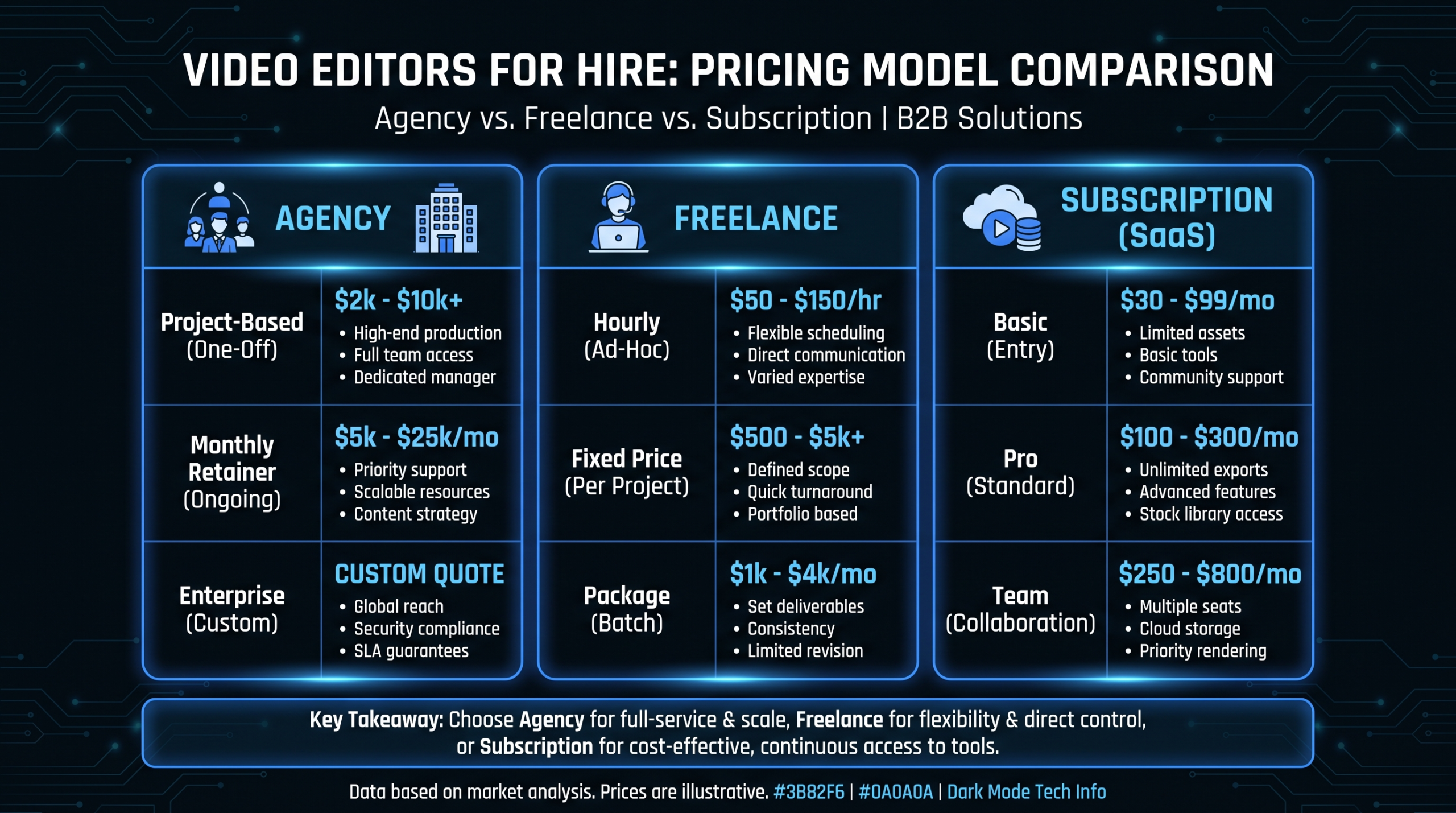
The agency and retainer market has a wide price range. Here's a realistic picture of what B2B SaaS companies pay for professional video editing support, from market context to specific plan structures.
Market Rate Context
For a full breakdown of how the agency pricing landscape is structured, see our guide to video production agency pricing models. The practical summary for B2B SaaS buyers: professional video editing retainers for growth-stage teams typically run $4,000–$20,000/month depending on output volume, content complexity, team structure, and whether you're getting shared capacity or a dedicated team. Lower-cost options exist but generally involve trade-offs in turnaround time, communication responsiveness, or consistency across videos.
VEC Retainer Tiers: Dedicated Teams at Each Scale
Video Editing Company structures its retainers around dedicated teams — not rotating freelancers, shared capacity pools, or unlimited-request queues. Each plan delivers a committed team that learns your brand and operates as an extension of your marketing department:
VEC Dedicated Team Plans — 2026
| Plan | Monthly Cost | Annual Cost | Typical Output | Ideal Stage |
|---|---|---|---|---|
| Growth | $5,000/mo | $60,000/yr | 8–14 videos/mo (mixed formats) | Series A — building the program |
| Core | $9,500/mo | $114,000/yr | 16–24 videos/mo | Series B — content-led growth |
| Scale | $16,000/mo | $192,000/yr | 30+ videos/mo, multi-format | Series C+ — full content operation |
All plans include a dedicated project manager, full brand onboarding, structured revision rounds, and VEC's core guarantee: double your video output within 90 days or month 4 is free. There are no equipment purchases, no recruiting fees, no sick-day coverage gaps, and no turnover risk on your side — the team is managed, backstopped, and replaced by VEC if needed.
For complete deliverable breakdowns by plan, see the VEC pricing page.
Head-to-Head: 10-Dimension Comparison
Here's where the complete picture comes into focus. This table compares a fully-loaded mid-level in-house hire against a market-rate agency retainer and the VEC Growth plan across every dimension that matters to a VP Marketing or Head of Content making this decision:
In-House vs Agency Retainer: Full Comparison
| Dimension | In-House (Mid-Level, Fully Loaded) | Agency Retainer (Market Rate) | VEC Growth Plan |
|---|---|---|---|
| Monthly cost | $10,642–$14,917 | $5,000–$12,000 | $5,000 |
| Annual cost (fully loaded) | $127,700–$179,000 | $60,000–$144,000 | $60,000 |
| First-year cost (incl. hiring) | $148,000–$215,000 | $60,000–$144,000 | $60,000 |
| Time to start producing | 30–90 days (hiring + ramp) | 1–2 weeks | ~1 week |
| Sick / vacation coverage | None — output pauses | Covered by agency team | Covered by VEC team |
| Scalability | Hire another person (3–6 months) | Upgrade tier or add retainer | Upgrade tier (days) |
| Brand consistency | High — after 3+ months of ramp | Variable — depends on agency structure | High — dedicated team learns your brand |
| Turnover risk | High — you absorb full recruiting cost | Low — managed by agency | Low — managed by VEC |
| Management time required | 3–5 hours/week of senior staff time | 1–2 hours/week | ~1 hour/week |
| Effective productive hours/mo | ~130–145 hrs (after PTO and holidays) | Committed contracted capacity | Committed contracted capacity |
The numbers shift depending on what you're measuring. On headline monthly cost, a mid-level in-house editor appears to cost roughly the same as a VEC Core retainer ($9,500/mo). But stack first-year hiring costs, the full benefits burden, equipment, software, management overhead, and amortized turnover — and the in-house option is dramatically more expensive and carries risks the retainer model eliminates entirely.
For a granular look at how per-video and per-minute costs compare across delivery models, our guides on video editing cost per minute and video editing hourly rates by country give the benchmarks you need for a complete comparison.
Running the Numbers for Your Stage
The right answer depends on your content volume, company stage, and how central video is to your growth strategy. Here are three scenarios that reflect common situations in B2B SaaS:
Scenario A — Series A, Building the Program (6–10 videos/month)
You're publishing product demos, webinar recordings, LinkedIn videos, and the occasional customer story. Volume is moderate, quality matters, and your budget needs to stretch across multiple channels.
- In-house mid-level hire (fully loaded): $127,700–$148,000/yr first year
- VEC Growth ($5,000/mo): $60,000/yr — covers equivalent or greater output with no overhead
- Savings with agency model: $67,700–$88,000/yr — enough to fund a full additional marketing headcount
At this stage, the agency model wins on cost by a wide margin. The in-house hire offers more day-to-day control, but at roughly double the cost for similar output. If you haven't yet built a repeatable video production process — scripting templates, feedback workflows, asset organization — this is also the wrong time to hire in-house. You're still figuring out what you need, and a good agency partner helps you figure that out faster.
Scenario B — Series B, Content-Led Growth (15–22 videos/month)
You have a real content operation. Video is a meaningful pipeline driver. You need consistent output across webinars, product update videos, social clips, and customer stories — week after week.
- In-house team (1 senior + 1 mid-level editor, fully loaded): $305,000–$365,000/yr
- VEC Core ($9,500/mo): $114,000/yr with a dedicated team and project manager
- Savings with agency model: $191,000–$251,000/yr
At this volume, the cost of a real in-house team becomes very significant. Two editors means two hiring cycles, two benefits packages, two equipment setups, doubled management overhead, and doubled turnover risk. The VEC Core plan — at roughly a third the cost — delivers the same output at scale with built-in redundancy and zero operational overhead on your side.
Scenario C — Series C+, Full Video Operation (30+ videos/month)
Video is now a core growth channel. You're producing across sales enablement, product marketing, content marketing, and brand — at volume and with consistent quality requirements. This is where the question finally gets interesting.
- In-house team (2 senior + 2 mid-level + creative director, fully loaded): $560,000–$720,000/yr
- VEC Scale ($16,000/mo): $192,000/yr
- Savings with agency model: $368,000–$528,000/yr
Even at scale, the math still favors the outsourced model for most B2B SaaS companies. The exception: if your video production requires highly proprietary creative knowledge that can't be efficiently briefed — or if you're genuinely building a media company within your company where editorial independence is a core product. For most Series C SaaS marketing teams, neither condition applies.
If you're evaluating whether to outsource video editing for the first time, the frameworks there apply directly to this decision. The short version: outsource until the operational case for in-house is airtight — not when it merely feels right.
"The decision to hire in-house should be driven by strategic control requirements, not perceived cost savings. At almost every volume level relevant to B2B SaaS, the fully-loaded cost of in-house video production significantly exceeds a well-structured agency retainer."
Frequently Asked Questions
What is the average fully-loaded cost of an in-house video editor?
For a mid-level video editor at a US B2B SaaS company, fully-loaded annual cost — including base salary, benefits burden, equipment, software, management overhead, and amortized turnover — typically falls in the $127,000–$175,000 range. A senior editor runs $165,000–$215,000/yr all-in. Year one is higher still, adding $20,000–$40,000 for recruiting fees, onboarding time, and the output shortfall during ramp. These numbers are consistently higher than most teams budget when the hire is approved.
At what volume does hiring in-house become more cost-effective than an agency?
The breakeven point in most scenarios is when you need the sustained equivalent of 3 or more full-time editors. Below that, the combined overhead of recruiting, benefits, equipment, software, and management makes in-house significantly more expensive than a structured retainer. Even at the 2-editor mark, the math is competitive but the in-house option still carries turnover and capacity gap risks that the agency model eliminates. Most Series A–B SaaS companies produce more cost-effectively — and with less operational distraction — through an outsourced model.
How much does it cost per video with an in-house editor vs an agency?
At full productivity, a mid-level in-house editor working 160 hours/month might produce 10–14 videos of mixed complexity. At $10,700/month fully loaded, that's roughly $765–$1,070 per video — before accounting for vacation, sick days, and the management time your senior staff spends on direction and feedback. Factor those in and effective cost per video typically lands 15–25% higher. For a detailed breakdown by format and delivery method, our guide on video editing cost per minute gives the benchmarks you need.
Is an agency retainer actually cheaper than a full-time video editor?
Yes — significantly so in most scenarios. A VEC Growth retainer at $5,000/month ($60,000/year) delivers comparable or greater output compared to a mid-level in-house editor who costs $127,000–$150,000/year fully loaded. The retainer also eliminates recruiting costs, benefits management, equipment purchasing cycles, and the productivity losses that happen when your editor is sick, on vacation, or transitioning out of the role. The only case where in-house consistently wins on cost is when you need the equivalent of 3+ dedicated editors and can sustain that volume long-term.
What hidden costs do companies most often underestimate when hiring in-house?
Three costs consistently get underestimated. First, the benefits multiplier: most people assume 20% on top of salary; the real number is 25–40% when you include payroll taxes, health insurance employer contribution, and 401(k) match. Second, management overhead: 3–5 hours per week of senior marketing staff time has a real dollar value — $11,000–$15,000/yr — that rarely appears in the hiring cost analysis. Third, turnover: with annual turnover in creative roles commonly running 18–30%, the amortized cost of recruiting and ramp time adds $8,000–$15,000/year to the effective cost of every in-house role. Research from Wistia's annual video in business benchmark consistently shows that companies with structured outsourced video infrastructure produce more content per dollar and per hour of marketing team time than teams that scaled primarily in-house.
Ready to See the Real Numbers for Your Team?
Skip the spreadsheet guesswork. Talk to our team and we'll model the exact cost comparison for your content volume, format mix, and current team setup — and show you what VEC would deliver against what you're spending today.
Book a Free Strategy Call See How It Works See Pricing