

You send footage to your editing team on Monday morning. When should you expect a first draft? Tuesday? Thursday? Next Monday? The answer depends on video type, complexity, team structure, and whether you've negotiated an SLA. Most businesses overpay for speed they don't need or accept timelines that are slower than industry standard — simply because they don't know what's reasonable. This guide breaks down realistic turnaround benchmarks for every major video type, explains how SLAs work in video editing partnerships, and shows you how to negotiate terms that align with your content cadence.
A Service Level Agreement (SLA) is a documented commitment between you and your editing partner that specifies expected turnaround times, quality standards, and remedies if those standards aren't met. In video editing, the SLA typically covers:
An SLA transforms "we'll get it to you soon" into "first draft in 3 business days, revisions in 24 hours, or we credit your account." The specificity matters — vague commitments are unenforceable and lead to frustration on both sides.
The SLA mindset: Your SLA isn't a weapon — it's a mutual commitment. It protects you from slow delivery AND protects your editing partner from unreasonable last-minute demands. Both sides benefit from documented expectations.
These benchmarks represent industry-standard timelines for professional editing teams (not individual freelancers) working with complete footage and clear briefs. Times start from when the editing team has both the creative brief and all raw footage.
| Video Type | First Draft | Revisions (2 rounds) | Total Duration |
|---|---|---|---|
| Social clip (30-60s) | 1-2 days | 1 day | 2-3 days |
| Podcast episode | 2-3 days | 1-2 days | 3-5 days |
| YouTube long-form (8-15 min) | 3-4 days | 2-3 days | 5-7 days |
| Customer testimonial (2-5 min) | 3-4 days | 2 days | 5-6 days |
| Product demo (2-5 min) | 4-5 days | 2-3 days | 6-8 days |
| Brand video (1-3 min) | 5-7 days | 3-4 days | 8-11 days |
| Motion graphics (1-2 min) | 7-10 days | 3-5 days | 10-15 days |
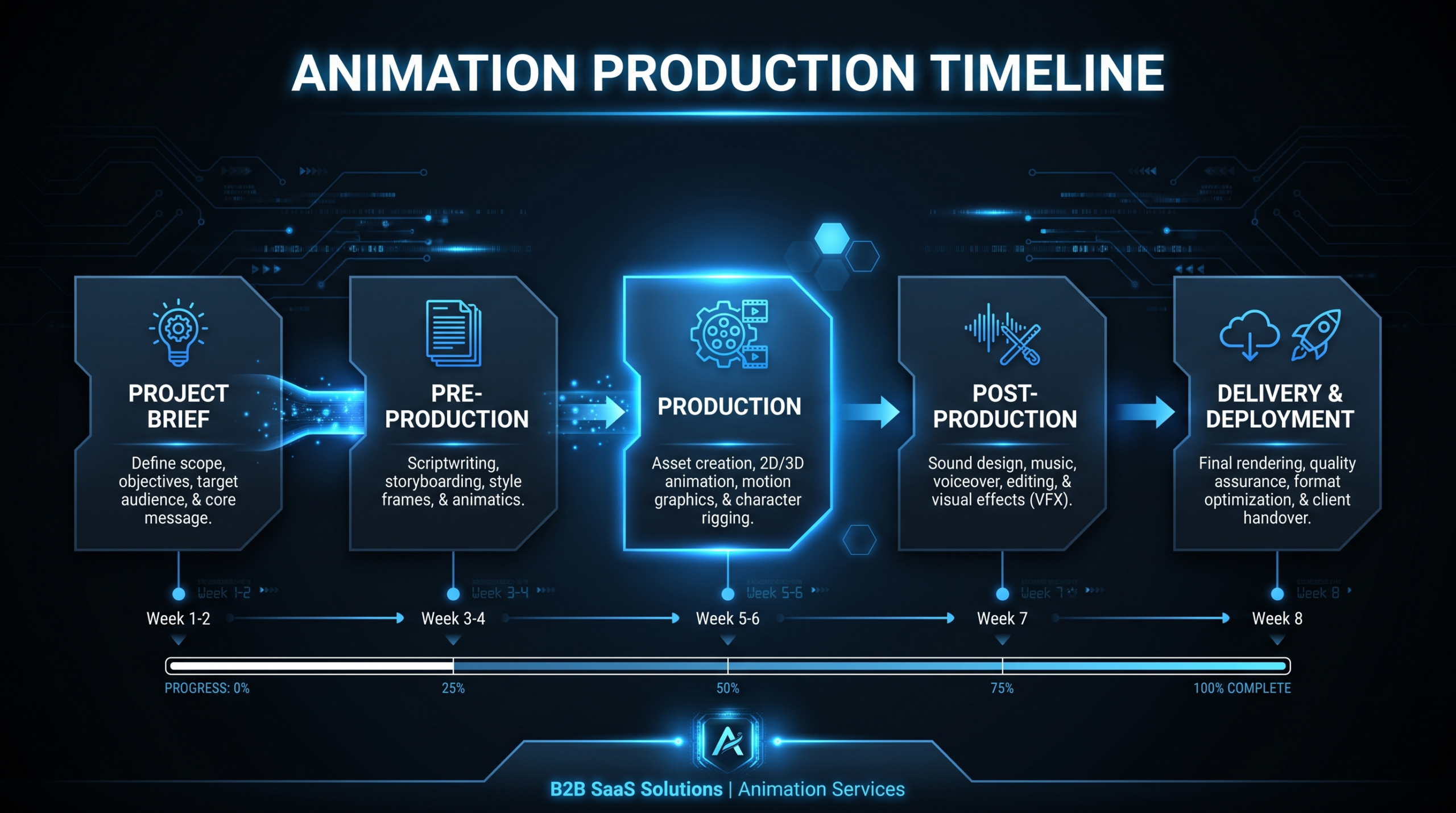
| Animated explainer (60-120s) | 10-14 days | 5-7 days | 15-21 days |
These timelines assume a dedicated team or experienced editor working at normal pace with complete footage and a clear brief. Freelancers may take 20-40% longer due to juggling multiple clients.
Organized footage (labeled clips, clear folder structure, shot list) can cut turnaround by 20-30%. Disorganized footage (unlabeled clips, mixed cameras in one folder, no shot descriptions) adds hours of sorting before editing begins.
A detailed brief with timestamps, reference videos, and specific instructions reduces first-draft turnaround by 15-25% and cuts revision rounds by 40-50%. Vague briefs ("make it engaging") add days in clarification cycles and revision loops.
A simple talking-head edit (one camera, one mic, cut out ums) is fundamentally different from a multi-cam shoot with B-roll, motion graphics, color grading, and sound design. Complexity multiplies turnaround by 1.5-3x.
| Complexity | Characteristics | Time Multiplier |
|---|---|---|
| Simple | Single source, minimal graphics, basic cuts | 1x (baseline) |
| Standard | Multi-cam, B-roll, lower thirds, music | 1.5-2x |
| Complex | Motion graphics, color grading, sound design, multiple formats | 2-3x |
| Premium | Custom animation, 3D elements, advanced compositing | 3-5x |
A dedicated editing team (same editors every project) delivers faster because they know your brand, preferences, and workflow. Rotating editors or freelancer pools require ramp-up time on every project.
Your editing team delivers a first draft in 3 days. You take 5 days to provide feedback. Now the project is 8 days in — and only through the first draft. Client-side feedback delays are the #1 cause of project duration overruns. Your SLA should include client obligations too.
If your editing team is processing 15 projects simultaneously, each individual project will take longer than if they had 5 in the queue. Understand your partner's current workload and plan submissions accordingly. Dedicated teams mitigate this because your work is their only work.
The most effective video editing SLAs use a tiered structure based on project priority:
| Tier | Priority | First Draft SLA | Revision SLA | Use Case |
|---|---|---|---|---|
| Tier 1: Rush | Urgent | 24-48 hours | 12-24 hours | Time-sensitive campaigns, breaking news responses, exec requests |
| Tier 2: Standard | Normal | 3-5 business days | 24-48 hours | Regular content cadence (YouTube uploads, social calendar) |
| Tier 3: Planned | Low | 5-10 business days | 48-72 hours | Evergreen content, internal videos, non-time-sensitive projects |
This tiered approach lets you pay rush pricing only when you need speed, while keeping standard projects at reasonable timelines and cost. Most companies run 70-80% of projects at Tier 2, 10-15% at Tier 3, and 5-10% at Tier 1.
Download our Video Production Workflow Template — includes SLA frameworks, brief templates, and revision tracking built in.
Download the Template See PricingRush delivery is a tool, not a crutch. Here's when it makes sense — and when it signals a planning problem.
| Turnaround | Typical Premium | Availability |
|---|---|---|
| Same day (8-12 hours) | 100% premium | Limited — depends on current queue |
| Next day (24 hours) | 50-75% premium | Usually available with advance notice |
| 48 hours | 25-50% premium | Widely available |
| Half standard time | 25% premium | Standard offering |
You can negotiate faster turnaround without paying rush premiums — if you bring something to the table:
Commit to volume. Higher monthly commitment = faster turnaround. Your partner can justify dedicating more resources when revenue is guaranteed. "If I commit to 15 videos/month on a 6-month term, can you guarantee 2-day turnaround on social clips?"
Improve your briefs. Offer to use a standardized brief template with all information your editor needs. Better input = faster output. Some partners will formalize this as a turnaround guarantee: "Complete brief + organized footage = guaranteed X-day turnaround."
Batch and schedule. Instead of sending projects randomly, batch similar work and submit on a predictable schedule. "Every Monday by noon, you'll receive 3-4 social clip briefs for delivery by Thursday." Predictability lets your partner plan resources efficiently.
Commit to fast feedback. Guarantee 24-hour feedback turnaround on your end. Partners who know they won't wait 5 days for your notes can plan their queue more aggressively.
Don't negotiate turnaround at the expense of quality. "Can you do it in 2 days instead of 4?" works if the team has capacity. It doesn't work if it means the editor skips quality checks or works through the night. Burned-out editors produce worse work — and that costs you more in revisions than you saved in turnaround.
An SLA you don't measure is just a wish. Track these metrics monthly:
| Metric | How to Calculate | Target |
|---|---|---|
| On-time delivery rate | % of first drafts delivered within SLA | >90% |
| Average turnaround | Mean business days from brief to first draft | Within SLA target ±0.5 days |
| Revision turnaround | Mean hours from feedback to revised draft | Within SLA target |
| Total project duration | Days from brief to final approval | Trending down over time |
| Revision rounds | Average revision rounds per video type | <2 for standard videos |
| Client-side delays | Days of delay caused by your team (late feedback, missing footage) | Trending down |
Review these metrics monthly with your editing partner. Data-driven conversations replace emotional negotiations. "Your on-time rate dropped from 92% to 78% last month — what happened?" is more productive than "You guys are always late."
Track both sides. Your editing partner's SLA performance is only half the picture. Track your own metrics too — brief submission timeliness, feedback turnaround, footage organization quality. Most turnaround issues trace back to client-side delays, not editing-side delays.
If you're new to video editing SLAs, here's a pragmatic approach:
Track your current turnaround times for 30 days without an SLA. This gives you a realistic baseline. If your partner currently delivers first drafts in 4-5 days, setting a 2-day SLA is unrealistic without additional investment.
Based on the baseline, set SLA targets that are 10-20% better than current performance. This is ambitious but achievable. Then improve quarterly.
Put the SLA in your Statement of Work. Include turnaround times, escalation procedures, and remedies for missed targets. Both sides sign.
Monthly SLA review meetings (30 minutes) where you review performance data, discuss outliers, and agree on improvements. This cadence keeps the SLA alive and evolving.
For a complete workflow template that includes SLA tracking, download our Video Production Workflow Template.
Book a call to discuss SLA terms that match your content cadence — with guaranteed delivery timelines backed by our dedicated team model.
Book a Call