Video for MarTech Companies: Stand Out in a Crowded Space
Table of Contents
Why MarTech Companies Need Video
MarTech is one of the fastest-growing segments in the SaaS landscape, and competition for buyer attention is intensifying. Companies in this space sell complex solutions to sophisticated buyers who evaluate multiple vendors before committing. Video is the format that bridges the gap between technical complexity and buyer comprehension.
The challenge for MarTech companies isn't just explaining what the product does - it's building trust, demonstrating domain expertise, and showing that you understand the specific workflows and pain points of your target audience. Text-based content struggles here because the nuances of MarTech are better shown than described.
Companies in this vertical that invest in strategic video content see measurable advantages: shorter sales cycles, higher conversion rates on demo requests, and stronger brand recall among target accounts. The opportunity is significant because most MarTech companies still rely primarily on text-heavy whitepapers and generic product screenshots.
Unique Challenges for MarTech Video
Producing effective video content for MarTech requires navigating industry-specific constraints that generic video strategies don't account for:
- Extreme market saturation: There are 11,000+ MarTech solutions competing for attention. Your video must immediately differentiate - buyers can't evaluate 50 product demos, so they shortlist based on first impressions. Your video is often that first impression.
- Sophisticated, skeptical buyers: MarTech buyers ARE marketers. They know every trick in the playbook because they use the same tactics. Your video must be genuinely excellent - they'll judge your marketing as a proxy for your product's marketing capabilities.
- Integration complexity: MarTech products don't exist in isolation. Buyers need to see how your tool integrates with their existing stack (CRM, CMS, analytics, ad platforms). Integration demos are often more important than feature demos.
- ROI attribution challenge: Proving MarTech ROI is meta-difficult: you're using marketing to sell marketing tools. Video must show clear, measurable outcomes from existing customers to cut through the 'sounds great in theory' objection.
- Rapid feature parity: MarTech features get commoditized quickly. Today's differentiator is tomorrow's table stakes. Video content needs to focus on approach, methodology, and results rather than features that competitors will replicate within months.
Video Types That Work for MarTech
Not every video format delivers equal ROI for MarTech companies. Based on buyer behavior and sales cycle patterns in this vertical, here are the video types that drive results:
| VIDEO TYPE | PURPOSE | LENGTH | FUNNEL STAGE |
|---|---|---|---|
| Platform Demo | Full product walkthrough with real workflows | 5-8 min | Mid-funnel |
| Integration Demo | Show connections to popular tools | 2-4 min | Mid-funnel |
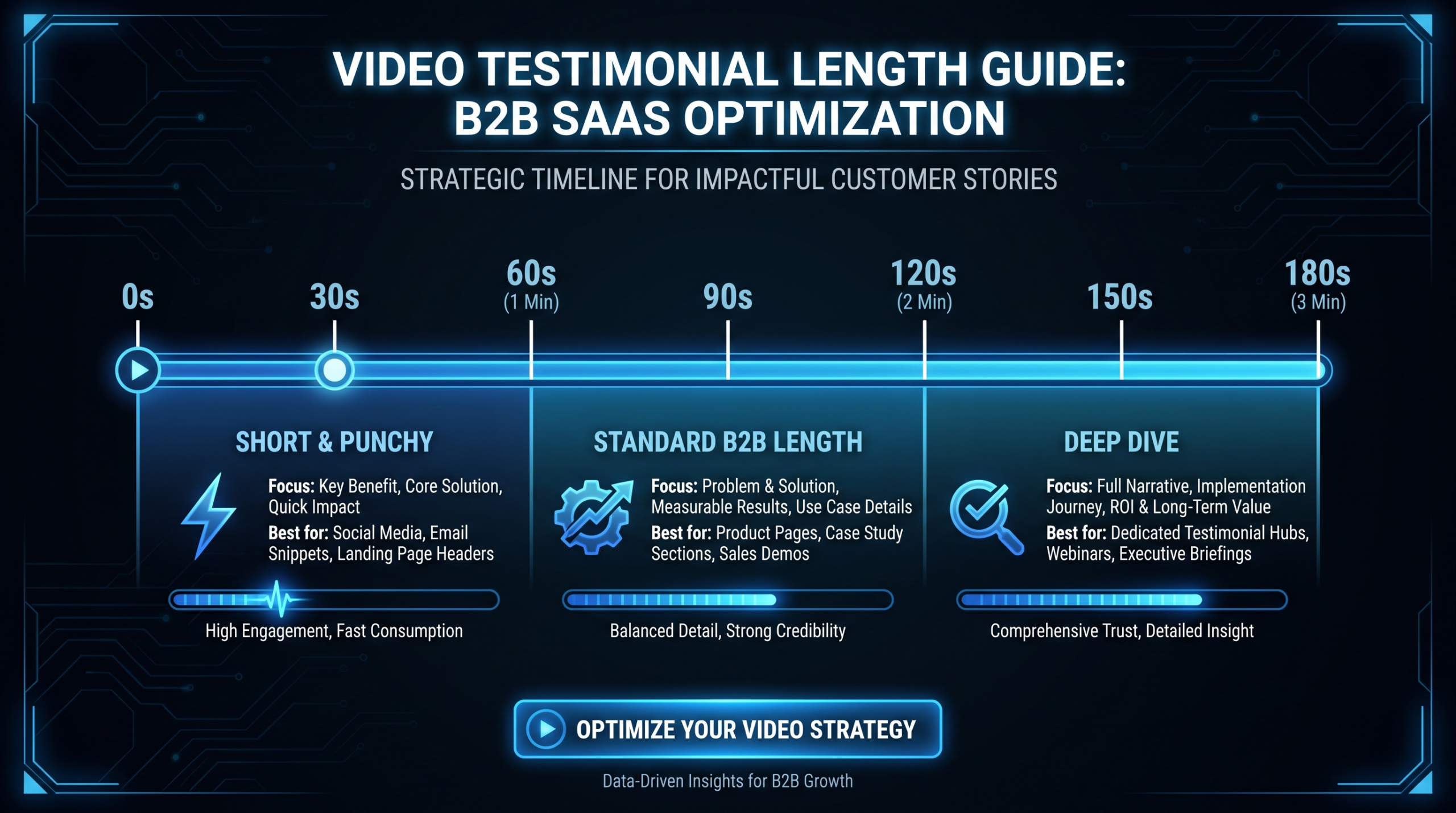
| ROI Case Study | Customer results with specific metrics | 2-3 min | Late funnel |
| 'Day in the Life' Video | Show daily workflow with your product | 3-5 min | Mid-funnel |
| Competitive Comparison | Honest feature and approach comparison | 3-5 min | Late funnel |
| Marketing Thought Leadership | Industry trends and best practices | 3-8 min | Top-funnel |
Product demonstration videos
Product demos are the single most-watched video type by B2B buyers (89% watch them during evaluation). For MarTech, demos need to show realistic workflows using your target customer's language and scenarios. Generic demos that don't reflect the industry's specific terminology and use cases will lose credibility with knowledgeable buyers.
Structure your demo around the buyer's daily challenges: start with the problem, show the solution in action, and quantify the outcome. Our product demo script template helps maintain this problem-solution-outcome structure consistently.
Customer testimonial videos
In MarTech, buyers want to see proof from companies like theirs. A testimonial from a company in a different vertical won't resonate the same way. Invest in capturing video testimonials from your most successful MarTech customers, focusing on specific metrics and workflow improvements rather than vague praise.
Thought leadership content
Position your executives as MarTech experts by producing videos on industry trends, regulatory changes, best practices, and market analysis. This content builds trust before the sales conversation begins and establishes your company as a knowledgeable partner, not just a vendor.
Use Cases & Strategy
Marketing automation platforms
Show the complete campaign workflow: build, target, launch, measure, optimize. Time-lapse videos showing a campaign being built in minutes that would take hours manually are compelling. Focus on the outcome dashboard showing engagement metrics and pipeline influence.
Analytics and attribution tools
Demonstrate the insights that are invisible without your platform. Show how scattered data becomes clear attribution models. Before/after visualizations of marketing reporting - from spreadsheets to dashboards - resonate strongly with marketing operations teams.
CMS and content platforms
Show the content creation, management, and distribution workflow. Focus on speed: how quickly a marketer can go from idea to published content. Compare your workflow to the clunky alternatives your prospects currently endure.
ABM and personalization platforms
Demonstrate account-level targeting, personalized content delivery, and engagement tracking. Show how your platform enables the 1:1 experiences that marketers want to deliver but can't achieve manually at scale.
Production Considerations
Technical accuracy is non-negotiable
MarTech buyers are domain experts. They'll catch inaccurate terminology, unrealistic scenarios, or oversimplified workflows immediately. Every video script should be reviewed by a subject matter expert before production. The cost of a credibility hit from an inaccurate video far exceeds the cost of proper review.
Data sensitivity and privacy
Any video showing product interfaces must use anonymized or synthetic data appropriate to the industry. Work with your compliance and product teams to create approved demo environments that look realistic without exposing sensitive information.
Production quality reflects product quality
Professional production signals professionalism. This doesn't mean Hollywood budgets - it means clean audio, proper lighting, thoughtful editing, and consistent branding. For MarTech companies selling to enterprise buyers, production quality is interpreted as a proxy for product quality.
Companies setting the standard
HubSpot
HubSpot produces massive volumes of educational video content that establishes authority across the entire marketing spectrum. Their strategy: be the most helpful resource in any marketing topic, and the product sells itself.
Drift
Drift pioneered conversational marketing video content - using their own platform to demonstrate the experience. Their videos showcase personality and energy that matches their brand positioning as a challenger.
6sense
6sense creates sophisticated ABM-focused videos that demonstrate their platform's predictive capabilities with real (anonymized) data. Their content targets the specific pain point of 'dark funnel' visibility that their competitors don't address.
Go-to-Market Video Strategy
Phase 1: Foundation (Month 1-2)
- 1 product overview/explainer video (90-120 seconds)
- 1 detailed product demo video (5-8 minutes)
- 2-3 customer testimonial videos (2-3 minutes each)
- Website integration across key conversion pages
Phase 2: Scale (Month 3-4)
- 3-5 use-case-specific demo variations
- Thought leadership video series for LinkedIn/YouTube
- Sales enablement clips for SDR outreach
- Webinar production and repurposing
Phase 3: Optimize (Month 5-6)
- Video analytics setup and performance tracking
- A/B testing video placements and messaging
- Video retargeting ads for website visitors
- Content refresh based on performance data
Budget framework
| VIDEO TYPE | TYPICAL COST | PRIORITY |
|---|---|---|
| Product demo | $3,000-8,000 | Must-have |
| Explainer video | $5,000-15,000 | Must-have |
| Customer testimonial | $2,000-5,000 each | Must-have |
| Thought leadership | $1,000-3,000 each | Nice-to-have |
| Social clips | $500-1,500/batch | Nice-to-have |
Total recommended first-year investment: $25,000-55,000 for a comprehensive video library. This produces 10-15 core assets that can be repurposed into 50+ content pieces.
Ready to Level Up Your Video Strategy?
Talk to our team about your video production needs. No commitment required.
Book a Free Strategy Call See PricingReady to get started? Explore our case studies.
Frequently Asked Questions
How do MarTech companies differentiate through video?
Focus on outcomes, not features. Every MarTech product has similar feature lists. The differentiation comes from showing specific results from specific customer segments: 'Marketing teams at 500-2000 employee SaaS companies see 40% improvement in pipeline attribution within 90 days.'
Should we show integrations in our demo videos?
Absolutely. MarTech buyers evaluate products as part of their stack, not in isolation. Dedicate at least one video to showing key integrations (Salesforce, HubSpot, Google Analytics, etc.) and how data flows between systems.
How do we convince MarTech buyers our product is different?
Through customer results videos, not feature comparisons. MarTech buyers are immune to feature marketing. Show them a customer who switched from a competitor and achieved specific improvements. Let the customer tell the differentiation story.
What's the ideal MarTech video production budget?
Higher than average because your audience judges production quality more harshly. Plan $35,000-65,000 for a first-year library. The customer testimonial videos are your highest-ROI investment - they're the most convincing content for skeptical marketing professionals.
Should MarTech companies focus on YouTube or LinkedIn?
Both, with different content. LinkedIn for short-form thought leadership and product clips (30-90 sec). YouTube for detailed product demos, tutorials, and educational series (5-15 min). LinkedIn drives awareness; YouTube supports evaluation.
SaaS Video Swipe File
50+ SaaS video examples including campaigns from leading MarTech companies.
Download Free