
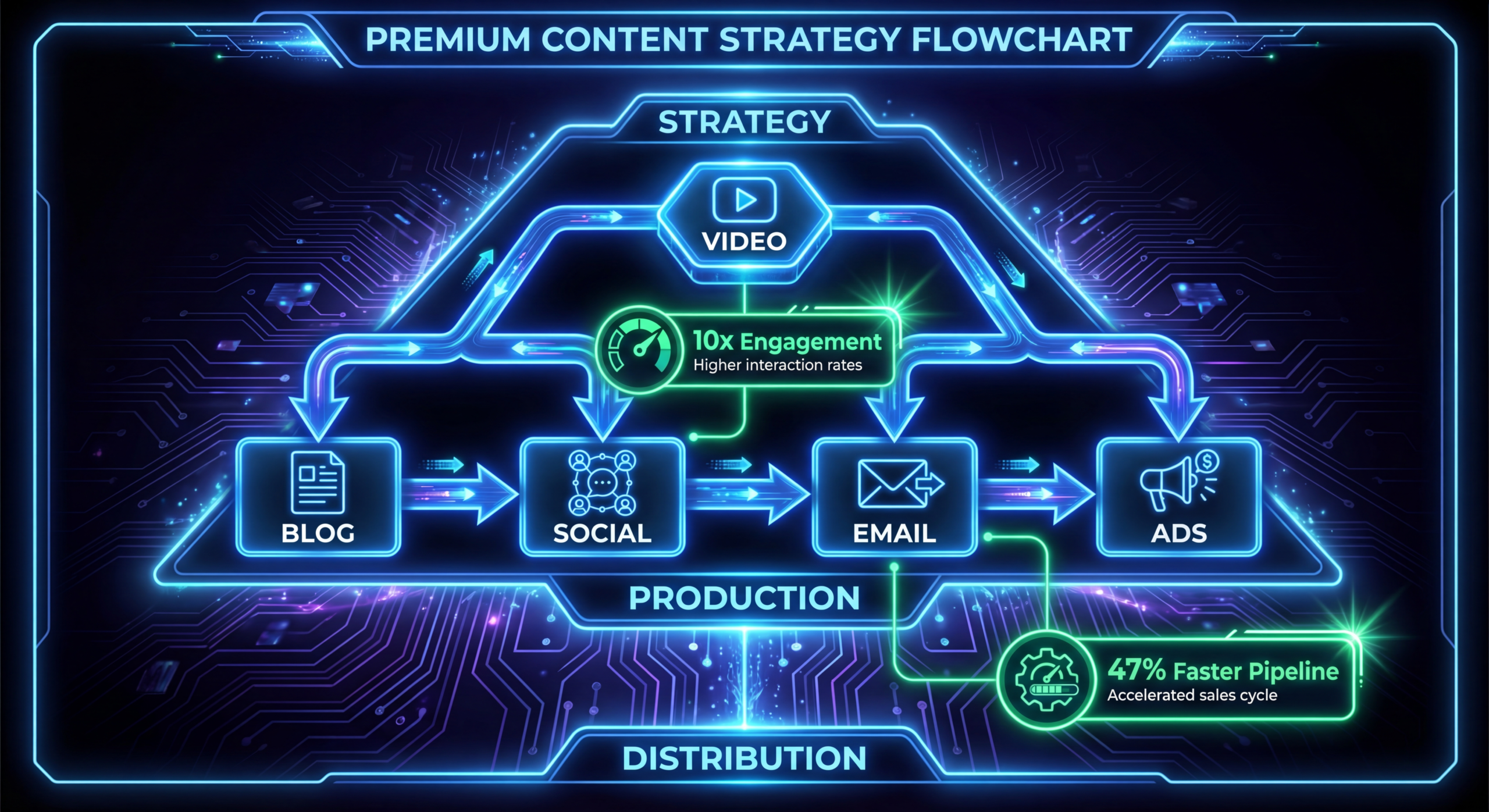
Most B2B content strategies start with blog posts, then add video as an afterthought — if they add it at all. A video-first strategy flips that. You start with video as the primary format, then derive everything else from it: blog posts, social content, email copy, sales assets. This isn't a philosophical preference. It's a production efficiency play. One 15-minute YouTube video contains enough raw material for 5-8 blog post outlines, 15-20 social clips, 3-5 email newsletter themes, and a dozen pull quotes. Start with video and the rest of your content calendar fills itself.
Video-first doesn't mean "only video." It means video is your primary content format — the source material from which all other content is derived. Here's the distinction:
| Traditional Approach | Video-First Approach |
|---|---|
| 1. Write a blog post | 1. Record a video |
| 2. Maybe create a video version later | 2. Transcribe → blog post |
| 3. Write social posts about the blog | 3. Extract clips → social content |
| 4. Write an email about the blog | 4. Pull key points → email newsletter |
| Result: 1 blog + maybe 1 video | Result: 1 video + 1 blog + 8-15 social pieces + 1 email |
The efficiency gain is dramatic. Instead of creating each content format from scratch, you create one "pillar" video and derive 10-20 pieces from it. Same ideas, multiple formats, fraction of the creative effort.
Algorithm preferences have shifted. LinkedIn, X/Twitter, Instagram, and even Google now actively prioritize video content in their feeds and search results. LinkedIn posts with native video get 5x the engagement of text posts. Google increasingly shows video results in search — and YouTube is the #2 search engine globally.
AI makes repurposing trivial. In 2026, tools like Descript, Opus Clip, and Riverside can automatically transcribe videos, identify highlight clips, generate social captions, and create blog post drafts. What used to take a VA 4-6 hours now takes 15 minutes of human review.
B2B buyers prefer video. 72% of B2B buyers say they'd rather watch a video than read a whitepaper. 59% of senior executives say they prefer video over text when both are available on the same page. Your audience is telling you what they want — and it's video.
Production costs have dropped. A dedicated editing team at $4K-$10K/month can process 15-30 videos. That's $130-$670 per video — cheaper than most blog posts when you factor in writer fees, editing, graphics, and SEO optimization.
The multiplier effect: A single 12-minute video, when properly repurposed, can generate the equivalent content output of 8-12 individually created pieces. Video-first doesn't require more budget — it requires reorganizing how you spend the same budget.
10-20 minute deep dive on one topic. This is your "atomic content unit" — everything else derives from this.
Transcribe, clip, summarize. Turn one video into 15-20 content pieces across formats and platforms.
YouTube, LinkedIn, Reels, blog, email, sales decks. Each platform gets native-optimized content.
Track engagement per platform. Double down on what works. Cut what doesn't. Refine topics quarterly.
| Content Tier | Format | Frequency | Effort |
|---|---|---|---|
| Pillar | YouTube video (10-20 min) | 1-2/week | High (original recording) |
| Derivative | Social clips, Reels, Shorts (30-90s) | 5-10/week | Low (clipped from pillar) |
| Written | Blog post (transcription + editing) | 1-2/week | Medium (editing transcription) |
| Audio | Podcast episode (extracted audio) | 1/week | Low (audio strip + intro/outro) |
| Newsletter with key insights | 1/week | Low (summarize pillar video) |
Your pillar videos should address questions your target audience actively searches for. Three sources for topic ideas:
You don't need a production studio. The minimum viable setup for quality B2B video:
Total cost: $200-$500 for a setup that produces professional-quality content. The recording quality of a $300 home studio in 2026 exceeds what broadcast studios produced 10 years ago.
Most B2B founders and executives sound better working from an outline (5-7 bullet points per section) than reading a script. Scripts sound scripted. Outlines sound conversational.
The exception: product demos and highly technical content. These benefit from scripting to ensure accuracy, proper feature coverage, and a logical flow.
This is where video-first becomes a superpower. One pillar video produces:
| Derivative | Platform | How to Create |
|---|---|---|
| 3-5 short clips (30-60s) | LinkedIn, Instagram Reels, TikTok, YouTube Shorts | Identify strongest 30-60s segments. Add captions. Crop to 9:16 |
| 1 blog post (1,500-3,000 words) | Website blog | Transcribe → edit for readability → add headers, images, CTAs |
| 1 podcast episode | Apple Podcasts, Spotify | Extract audio → add intro/outro music → publish as podcast |
| 1 email newsletter | Email list | Summarize 3 key takeaways → link to full video |
| 3-5 quote graphics | LinkedIn, Twitter/X, Instagram | Pull best quotes → design branded graphics |
| 1 carousel post | Turn key framework/steps into a 6-10 slide carousel | |
| 1 audiogram | Instagram, Twitter/X | 30-second audio clip with waveform animation |
That's 12-18 content pieces from one recording session. If you do 2 pillar videos per week, you produce 100-140+ pieces per month. This is how video-first companies seem to be everywhere — they're not creating more, they're extracting more from what they create.
Pre-built for video-first B2B SaaS — includes pillar video planning, repurposing workflows, and distribution checklists.
Download the Template See PricingRunning a video-first content strategy requires these roles (not necessarily people — one person can cover multiple roles):
For a Series A company: the founder + an external editing team + a content marketer can run a video-first strategy producing 8-12 pillar videos per month with 80-120 derivative pieces. Total cost: $5K-$10K/month for editing + one content marketer salary.
| Metric | Where to Track | Target (After 6 Months) |
|---|---|---|
| YouTube watch hours | YouTube Studio | Growing 15-25% month over month |
| Average view duration | YouTube Studio | >40% of video length |
| LinkedIn video views | LinkedIn Analytics | 500-2,000 per clip for B2B |
| Organic blog traffic from video posts | Google Analytics | Video-derived posts ranking for target keywords |
| Email subscribers from video CTAs | Email platform | 5-15 new subscribers per pillar video |
| Sales team usage | CRM / Sales team feedback | Videos being shared in 30%+ of deal cycles |
Don't commit to daily pillar videos on day one. Start with 1 per week for 8 weeks. Prove the system works, refine the workflow, then scale. Consistency at a sustainable pace beats bursts of ambition followed by burnout.
Viewers forgive mediocre video quality. They don't forgive bad audio. Invest in a quality microphone before investing in a better camera. Bad audio = immediate bounce.
Creating pillar videos without extracting derivatives defeats the purpose of video-first. If your pillar video lives only on YouTube, you're capturing 20% of its potential value. The repurposing engine is the strategy.
Your first videos will not be your best. Ship them anyway. A B+ video published today beats an A+ video that lives in draft for 3 months. Quality improves with practice, not with planning.
Publishing a video on YouTube and waiting for views is not distribution. Each pillar video should have a launch plan: LinkedIn post on day 1, email mention on day 2, blog post on day 3, social clips throughout the week. Distribution is half the job.
For more on distribution, read our guide on video distribution strategy for B2B SaaS. For help building a video library your sales team will actually use, check how our process works.
Book a call to discuss how a dedicated editing team can power your video-first content engine — from pillar videos to social clips.
Book a Call